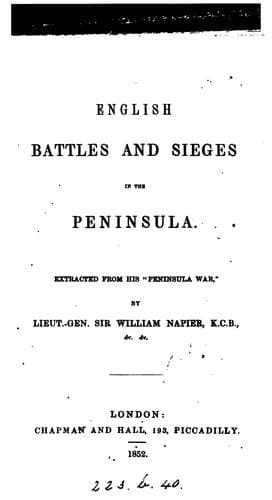
English Battles and Sieges in the Peninsula.: Extracted from his 'Peninsula War'.Napier, William Francis Patrick
History
English Battles and Sieges in the Peninsula.: Extracted from his 'Peninsula War'.
Napier, William Francis Patrick
Peninsular War, 1807-1814
On the 21st the besiegers sent a summons, the governor refused to
receive the letter, the firing was renewed, and though the main wall
resisted the parapets crumbled; the batteries on Monte Olia also
plunged into the horn-work at sixteen hundred yards’ distance, with
such effect that the besieged, having no bomb-proofs, were forced to
dig trenches to protect themselves. The French fire, directed solely
against the breaching batteries, was feeble, but at midnight a shell
thrown from the castle into the bay gave the signal for a sally, during
which French vessels with supplies entered the harbour. The besieged
now isolated the breach by cuts in the rampart and other defences, yet
the besiegers’ parallel across the isthmus was completed, and in its
progress laid bare the mouth of a drain four feet high and three feet
wide, containing the pipe of the aqueduct cut off by the Spaniards.
Through that dangerous opening Lieutenant Reid,[30] a young and zealous
engineer, crept even to the counterscarp of the horn-work, where he
found the passage closed and returned. Thirty barrels of powder were
placed in this drain, and eight feet was stopped with sand-bags,
forming a globe of compression to blow, as through a tube, so much
rubbish over the counterscarp as might fill the narrow ditch of the
horn-work.
On the 22nd the fire from the batteries, unexampled from its rapidity
and accuracy, opened what appeared a practicable breach in the eastern
flank wall, between two towers called Los Hornos and Las Mesquitas; but
the descent into the town behind this breach was more than twelve feet
perpendicular, and the garrison were seen from Monte Olia diligently
working at the interior defences to receive the assault: they added
also another gun to the battery of St. Elmo, just under the Mirador
battery, to flank the front attack. On the other hand the besiegers
had placed four sixty-eight pound carronades in battery to play on the
defences of the breach, yet the fire was slack because the guns were
now greatly enlarged at the vents.
On the 23rd, the sea blockade being null, the French vessels carried
off the badly-wounded men. This day also the besiegers, judging
the breach between the towers practicable, turned the guns, at the
suggestion of General Oswald, to break the wall on the right of the
main breach. Smith opposed this, urging, that no advantage would be
gained by making a second opening, to get at which the troops must
first pass the great breach; time would be thus lost, and there was a
manifest objection on account of the tide and depth of water at the new
point attacked. His counsel was overruled, and in the course of the
day, the wall being thin, the stroke heavy and quick, a second breach
thirty feet wide was rendered practicable.
Public-domain text, read in full here on John Shaqi.
Reviews
Reviews
No reviews yet
Be the first to share your thoughts on this work.
Elsewhere in the archive
Join the Discussion
Join the discussion
Sign in to leave a comment or review.
Sign InorCreate an account