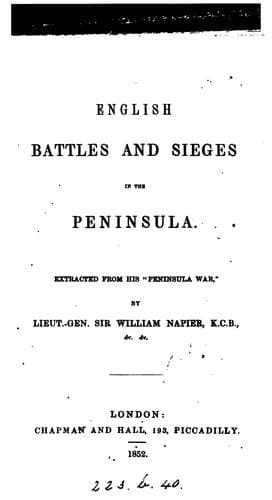
English Battles and Sieges in the Peninsula.: Extracted from his 'Peninsula War'.Napier, William Francis Patrick
History
English Battles and Sieges in the Peninsula.: Extracted from his 'Peninsula War'.
Napier, William Francis Patrick
Peninsular War, 1807-1814
Bayonne, a fortress of no great strength, had been entirely neglected.
But the arming and provisioning that and other places; the restoration
of an intrenched camp, originally traced by Vauban to cover Bayonne;
the enforcement of discipline; the removal of the immense train of
Joseph’s wasteful court; the establishment of a general system for
supplies, and judicious efforts to stimulate the civil authorities and
excite the national spirit, soon indicated the presence of a great
commander. The soldiers’ confidence then revived, and some leading
merchants of Bayonne zealously seconded the general: the people were
however more inclined to avoid burdens than to answer calls on their
patriotism.
Soult examined the line of military positions on the 14th, and ordered
Reille, who then occupied the passes of Vera and Echallar, to prepare
pontoons for throwing two bridges over the Bidassoa at Biriatou;
Wellington, as before said, drove him from those passes next day,
yet he prepared his bridges, and by the 16th, Soult was ready for a
gigantic offensive movement.
His army was divided into three corps of battle and a reserve. Clausel
with the left was at St. Jean Pied de Port, and in communication, by
the French frontier, with a division under General Paris at Jaca,
belonging to Suchet but under Soult’s orders.
Drouet, Count D’Erlon, with the centre, occupied the heights near
Espelette and Ainhoa.
Reille with the right wing was on the mountains overlooking Vera from
the side of France.
The reserve, under Villatte, guarded the right bank of the Bidassoa
from the mouth to Irun, at which place the stone bridge was destroyed.
The heavy cavalry under Trielhard, and the light horsemen under Pierre
Soult, the marshal’s brother, were on the banks of the Nive and the
Adour.
To oppose this force Wellington had in Navarre and Guipuscoa above a
hundred thousand men. Of these the Anglo-Portuguese furnished fifty
thousand infantry and seven thousand cavalry; the Spanish regulars
under Giron, Abispal, and Carlos España, about twenty-five thousand
infantry; the rest were irregular; and hence the troops in line were,
of the allies, eighty-two thousand, of the French seventy-eight
thousand.
Public-domain text, read in full here on John Shaqi.
Reviews
Reviews
No reviews yet
Be the first to share your thoughts on this work.
Elsewhere in the archive
Join the Discussion
Join the discussion
Sign in to leave a comment or review.
Sign InorCreate an account