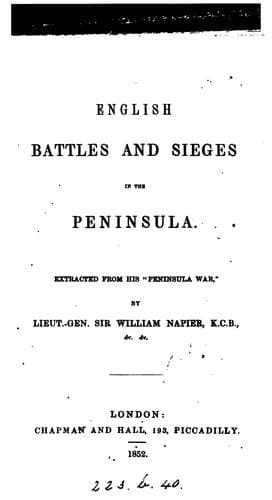
English Battles and Sieges in the Peninsula.: Extracted from his 'Peninsula War'.Napier, William Francis Patrick
History
English Battles and Sieges in the Peninsula.: Extracted from his 'Peninsula War'.
Napier, William Francis Patrick
Peninsular War, 1807-1814
That day the French losses were great, yet Wellington was justly
discontented with the result. Neither Longa nor Alten had fulfilled
their missions. The former should have stopped D’Erlon; the latter
should have passed the bridge of Yanzi and struck a great blow: it was
for that his soldiers had made such a prodigious exertion.
In the night Soult rallied his divisions about Echallar, and on the
morning of the 2nd occupied the Puerto of that name. His left was
on the rocks of Zagaramurdi, his right, on the Ivantelly mountain,
communicating with Villatte, who held certain ridges between the
Ivantelly and the head of the great Rhune mountain. Clausel’s three
divisions, reduced to six thousand men, were on a strong hill between
the Puerto and town of Echallar. This position was momentarily adopted
by Soult to make Wellington discover his final object, but that general
would not suffer the affront. He had the fourth, seventh, and light
divisions in hand, and resolved to fall upon Clausel, whose position
was dangerously advanced.
COMBATS OF ECHALLAR AND IVANTELLY. (Aug. 1813.)
From Yanzi the light division marched to the heights of Santa Barbara,
which were connected with the Ivantelly, thus turning Clausel’s
position and menacing Soult’s right, while the fourth division moved
to attack his front, and the seventh menaced his left; these attacks
were to be simultaneous, but General Barnes led his brigade of the
seventh division against Clausel’s strong post before the fourth and
light divisions were seen or felt. A vehement fight ensued, yet neither
the steepness of the mountain, nor the overshadowing multitude of
the enemy, clustering above in support of their skirmishers, could
arrest the assailants, and the astonishing spectacle was presented of
fifteen hundred men, driving by sheer valour and force of arms six
thousand good troops from ground so rugged, the numbers might have been
reversed and the defence made good without much merit. Incalculable
is the preponderance of moral power in war! These were the Frenchmen
who had assailed the terrible rocks above Sauroren with a force and
energy that all the valour of the hardiest British veterans scarcely
sufficed to repel; yet now, five days only having elapsed, although
posted so strongly, they did not sustain the shock of one-fourth of
their own numbers! And at this very time, eighty British soldiers,
the comrades and equals of those who achieved this wonderful exploit,
having wandered to plunder, surrendered to some French peasants, who as
Lord Wellington truly observed, “_they would under other circumstances
have eat up_!” What gross ignorance of human nature then do those
writers display, who assert, that the use of brute force is the highest
qualification of a general!
Public-domain text, read in full here on John Shaqi.
Reviews
Reviews
No reviews yet
Be the first to share your thoughts on this work.
Elsewhere in the archive
Join the Discussion
Join the discussion
Sign in to leave a comment or review.
Sign InorCreate an account