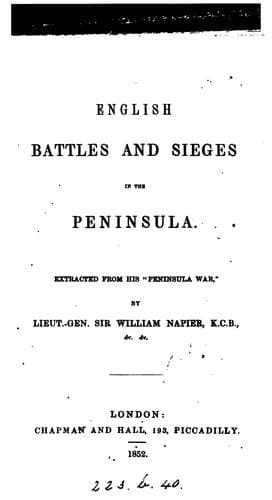
English Battles and Sieges in the Peninsula.: Extracted from his 'Peninsula War'.Napier, William Francis Patrick
History
English Battles and Sieges in the Peninsula.: Extracted from his 'Peninsula War'.
Napier, William Francis Patrick
Peninsular War, 1807-1814
Now, after nine days of continual movement during which ten serious
actions had been fought, the operations ceased. Of the allies,
including the Spaniards, seven thousand three hundred officers and
soldiers had been killed, wounded, or taken, and many were dispersed
from fatigue or to plunder. On the French side the loss was terrible,
and the disorder rendered the official returns inaccurate. Wellington
called it twelve thousand, but hearing the French officers admitted
more, raised his estimate to fifteen thousand. The engineer _Belmas_,
in his Journals of Sieges compiled from official documents, sets down
above thirteen thousand. Soult in his official correspondence at the
time, gave fifteen hundred for Maya, four hundred for Roncesvalles, two
hundred on the 27th, eighteen hundred the 28th, after which he spoke
no more of losses by battle. There remain therefore to be added, the
combats of Linzoain, the battles of Sauroren and Buenza on the 30th,
the combats on the 31st, 1st and 2nd: finally, four thousand unwounded
prisoners. Let this suffice. It is not needful to sound the stream of
blood in all its horrid depths.
BOOK XII.
Catalonia--Combat of Ordal--Renewed Siege of San Sebastian--Storm
of San Sebastian--Battles on the Bidassoa--Combat of San
Marcial--Combat of Vera.
CATALONIA. (Sept. 1813.)
While Wellington was thus victorious in Navarre, Lord W. Bentinck,
having reorganized Murray’s army at Alicant, was pushing the war in
Catalonia; for to that province Suchet retired after the battle of
Vittoria, relinquishing Valencia and Aragon, though he knew Clausel was
at Zaragoza. But in every way his determination to act independently,
however injurious it might prove to the emperor’s interest, was
apparent. Had he joined Clausel, forty-five thousand men, well based
on fortresses, would have menaced Wellington’s right flank when Soult
took the command: neither Sebastian nor Pampeluna could then have been
invested, and Soult’s recent defeats would have been spared.
Lord William Bentinck had command of the Spanish armies as well as his
own, and Lord Wellington had planned a cautious scheme for renewed
operations, with reference to his own position in the Pyrenees: but
Lord William, whose thoughts were running on Sicily and an invasion of
Italy, pushed headlong into Catalonia, and though a brave and able man
he did not meet with much success. Having passed the Ebro late in July,
leaving the fortress of Tortoza behind him, he on the 30th sat down
before Tarragona with his own and Del Parque’s armies.
Public-domain text, read in full here on John Shaqi.
Reviews
Reviews
No reviews yet
Be the first to share your thoughts on this work.
Elsewhere in the archive
Join the Discussion
Join the discussion
Sign in to leave a comment or review.
Sign InorCreate an account