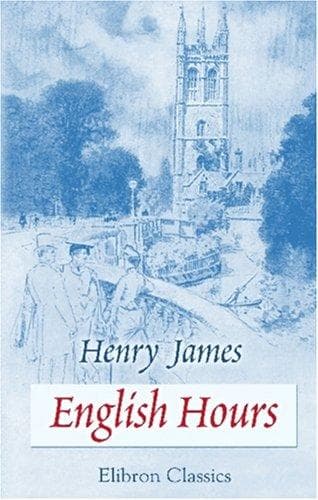
England -- Description and travel; James, Henry, 1843-1916 -- Travel -- England
It was not only at Stokesay that I lingered a while on the summit
of the keep to enjoy the complete impression so overtaken. I spent
such another half-hour at Ludlow, which is a much grander and more
famous monument. Ludlow, however, is a ruin—the most impressive and
magnificent of ruins. The charming old town and the admirable castle
form a capital object of pilgrimage. Ludlow is an excellent example of
a small English provincial town that has not been soiled and disfigured
by industry; it exhibits no tall chimneys and smoke-streamers, no
attendant purlieus and slums. The little city is perched upon a hill
near which the goodly Severn wanders, and it has a remarkable air
of civic dignity. Its streets are wide and clean, empty and a little
grass-grown, and bordered with spacious, mildly-ornamental brick houses
which look as if there had been more going on in them in the first
decade of the century than there is in the present, but which can still
nevertheless hold up their heads and keep their window-panes clear,
their knockers brilliant, and their door-steps whitened. The place
seems to say that some hundred years ago it was the centre of a large
provincial society and that this society was very “good” of its kind.
It must have transported itself to Ludlow for the season—in rumbling
coaches and heavy curricles—and there entertained itself in decent
emulation of that more majestic capital which a choice of railway lines
had not as yet placed within its immediate reach. It had balls at the
assembly rooms; it had Mrs. Siddons to play; it had Catalani to sing.
Miss Burney’s and Miss Austen’s heroines might perfectly well have had
their first love-affair there; a journey to Ludlow would certainly have
been a great event to Fanny Price or Emma Woodhouse, or even to those
more romantically-connected young ladies Evelina and Cecilia. It is a
place on which a provincial aristocracy has left so sensible a stamp as
to enable you to measure both the grand manners and the small ways. It
is a very interesting array of houses of the period after the poetry
of domestic architecture had begun to wane and before the vulgarity
had come—a fine familiar classic prose. Such places, such houses,
such relics and intimations, carry us back to the near antiquity of
that pre-Victorian England which it is still easy for a stranger to
picture with a certain vividness, thanks to the partial survival of
many of its characteristics. It is still easier for a stranger who
has dwelt a time in England to form an idea of the tone, the habits,
the aspect of the social life before its classic insularity had begun
to wane, as all observers agree that it did about thirty years ago.
It is true that the mental operation in this matter reduces itself to
our imaging some of the things which form the peculiar national notes
as infinitely exaggerated: the rigidly aristocratic constitution of
society, the unæsthetic temper of the people, the small public fund of
convenience, of elegance.
Public-domain text, read in full here on John Shaqi.
Reviews
Reviews
No reviews yet
Be the first to share your thoughts on this work.
Elsewhere in the archive
Join the Discussion
Join the discussion
Sign in to leave a comment or review.
Sign InorCreate an account