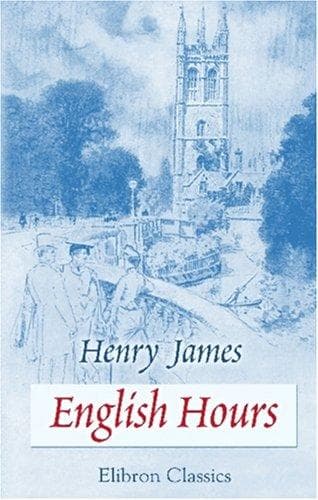
England -- Description and travel; James, Henry, 1843-1916 -- Travel -- England
hedges which lay around its shoulders like loosened strings of coral
and begun to ascend the grassy cone (very much in the attitude of
Nebuchadnezzar), it proved as smooth-faced as a garden-mound. Hard by,
on the flanks of other hills, were troops of browsing sheep, and the
only thing that confessed in the least to a point or an edge was the
strong, damp wind. But even the high breeze was good-humoured and only
wanted something to play with, blowing about the pearly morning mists
that were airing themselves upon neighbouring ridges and shaking the
vaporous veil that fluttered down in the valley over the picturesque
little town of Abergavenny. A breezy, grassy English hill-top, looking
down on a country full of suggestive names and ancient memories and
implied stories (especially if you are exhilarated by a beautiful walk
and have a flask in your pocket), shows you the world as a very smooth
place, fairly rubbed so by human use.
I was warned away from church, on Sunday, by my mistrust of its
mediæval chill—lumbago there was so clearly catching. In the still
hours, when the roads and lanes were empty, I simply walked to the
churchyard and sat upon one of the sun-warmed gravestones. I say the
roads were empty, but they were peopled with the big primroses I just
now spoke of—primroses of the size of ripe apples and yet, in spite of
their rank growth, of as pale and tender a yellow as if their gold had
been diluted with silver. It was indeed a mixture of gold and silver,
for there was a wealth of the white wood-anemone as well, and these
delicate flowers, each of so perfect a coinage, were tumbled along the
green wayside as if a prince had been scattering largess. The outside
of an old English country church in service-time is a very pleasant
place; and this is as near as I often dare approach the celebration
of the Anglican mysteries. A just sufficient sense of their august
character may be gathered from that vague sound of village music
which makes its way out into the stillness and from the perusal of
those portions of the Prayer-Book which are inscribed upon mouldering
slabs and dislocated headstones. The church I speak of was a beautiful
specimen of its kind—intensely aged, variously patched, but still
solid and useful and with no touch of restoration. It was very big and
massive and, hidden away in the fields, had a kind of lonely grandeur;
there was nothing in particular near it but its out-of-the-world little
parsonage. It was only one of ten thousand; I had seen a hundred such
before. But I watched the watery sunshine upon the rugosities of its
ancient masonry; I stood a while in the shade of two or three spreading
yews which stretched their black arms over graves decorated for Easter,
according to the custom of that country, with garlands of primrose and
dog-violet; and I reflected that in a “wild” region it was a blessing
to have so quiet a place of refuge as that.
Public-domain text, read in full here on John Shaqi.
Reviews
Reviews
No reviews yet
Be the first to share your thoughts on this work.
Elsewhere in the archive
Join the Discussion
Join the discussion
Sign in to leave a comment or review.
Sign InorCreate an account