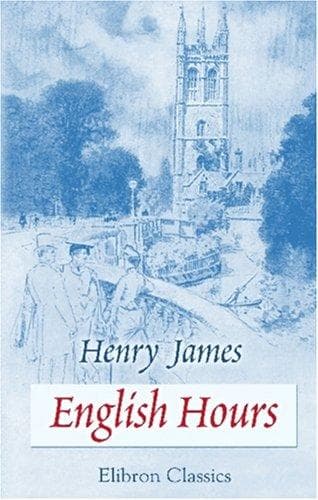
England -- Description and travel; James, Henry, 1843-1916 -- Travel -- England
This description, however, is lacking in the element of gentility,
and I will not pursue it farther, for I should give a very false
impression of Hastings if I were to omit so characteristic a feature.
It was, I think, the element of gentility that most impressed me. I
know that the word I have just ventured to use is under the ban of
contemporary taste; so I may as well say outright that I regard it as
indispensable in almost any attempt at portraiture of English manners.
It is vain for an observer of such things to pretend to get on without
it. One may talk of foreign life indefinitely—of the manners and
customs of France, Germany, and Italy—and never feel the need of this
suggestive, yet mysteriously discredited, epithet. One may survey the
remarkable face of American civilisation without finding occasion to
strike this particular note. But in England no circumlocution will
serve—the note must be definitely struck. To attempt to speak of an
English watering-place in winter and yet pass it over in silence would
be to forfeit all claims to the analytic spirit. For a stranger, at
any rate, the term is invaluable—it is more convenient than I should
find easy to say. It is instantly evoked in my mind by long rows of
smuttily-plastered houses, with a card inscribed “Apartments” suspended
in the window of the ground-floor sitting-room—that portion of the
dwelling which is known in lodging-house parlance as “the parlours.”
Everything, indeed, suggests it—the bath-chairs, drawn up for hire in
a melancholy row; the innumerable and excellent shops, adorned with
the latest photographs of the royal family and of Mrs. Langtry; the
little reading-room and circulating library on the Parade, where the
daily papers, neatly arranged, may be perused for a trifling fee, and
the novels of the season are stacked away like the honeycombs in an
apiary; the long pier, stretching out into the sea, to which you are
admitted by the payment of a penny at a wicket, and where you may enjoy
the music of an indefatigable band, the enticements of several little
stalls for the sale of fancy-work, and the personal presence of good
local society. It is only the winking, twinkling, easily-rippling sea
that is not genteel. But, really, I was disposed to say at Hastings
that if the sea was not genteel, so much the worse for Neptune; for
it was the favourable aspect of the great British proprieties and
solemnities that struck me. Hastings and St. Leonards, with their
long, warm sea-front and their multitude of small, cheap comforts
and conveniences, offer a kind of résumé of middle-class English
civilisation and of advantages of which it would ill become an American
to make light. I don’t suppose that life at Hastings is the most
exciting or the most gratifying in the world, but it must certainly
have its advantages. If I were a quiet old lady of modest income and
nice habits—or even a quiet old gentleman of the same pattern—I should
certainly go to Hastings.
Public-domain text, read in full here on John Shaqi.
Reviews
Reviews
No reviews yet
Be the first to share your thoughts on this work.
Elsewhere in the archive
Join the Discussion
Join the discussion
Sign in to leave a comment or review.
Sign InorCreate an account