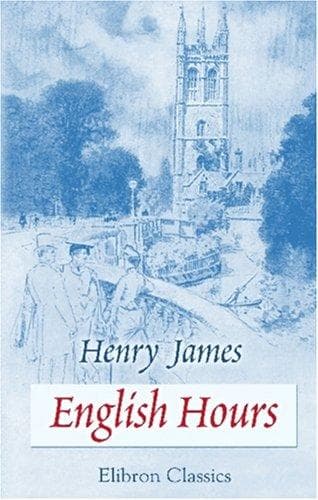
England -- Description and travel; James, Henry, 1843-1916 -- Travel -- England
The glimpses I speak of are, in all directions, the constant company of
the afternoon “spin.” Beginning, modestly enough, at Dunwich itself,
they end, for intensity, as far inland as you have time to go; far
enough—this is the great point—to have shown you, in their quiet
vividness of type, a placid series of the things into which you may
most read the old story of what is softest in the English complexity.
I scarce know what murmur has been for weeks in my ears if it be not
that of the constant word that, as a recall of the story, may serve
to be put under the vignette. And yet this word is in its last form
nothing more eloquent than the mere admonition to be pleased. Well, so
you are, even as I was yesterday at Wesselton with the characteristic
“value” that expressed itself, however shyly, in the dear old red inn
at which I halted for the queer restorative—I thus discharge my debt to
it—of a bottle of lemonade with a “dash.” The dash was only of beer,
but the refreshment was immense. So even was that of the sight of a
dim, draped, sphinx-like figure that loomed, at the end of a polished
passage, out of a little dusky back parlour which had a windowful of
the choked light of a small green garden—a figure proving to be an
old woman desirous to dilate on all the years she had sat there with
rheumatism “most cruel.” So, inveterately—and in these cases without
the after-taste—is that of the pretty little park gates you pass to
skirt the walls and hedges beyond which the great affair, the greatest
of all, the deep, still home, sits in the midst of its acres and
strikes you all the more for being, precisely, so unrenowned. It is the
charming repeated lesson that the amenity of the famous seats in this
country is nothing to that of the lost and buried ones. This impression
in particular may bring you round again harmoniously to Dunwich and
above all perhaps to where the Priory, laid, as I may say, flat on its
back, rests its large outline on what was once the high ground, with
the inevitable “big” house, beyond and a little above, folded, for
privacy, in a neat, impenetrable wood. Here as elsewhere the cluster
offers without complication just the signs of the type. At the base of
the hill are the dozen cottages to which the village has been reduced,
and one of which contains, to my hearing, though by no means, alas, to
his own, a very ancient man who will count for you on his fingers, till
they fail, the grand acres that, in his day, he has seen go the way of
the rest. He likes to figure that he ploughed of old where only the sea
ploughs now. Dunwich, however, will still last his time; and that of as
many others as—to repeat my hint—may yet be drawn here (though not, I
hope, on the instance of these prudent lines) to judge for themselves
into how many meanings a few elements can compose. One never need be
bored, after all, when “composition” really rules. It rules in the way
the brown hamlet really disposes itself, and the grey square tower of
Public-domain text, read in full here on John Shaqi.
Reviews
Reviews
No reviews yet
Be the first to share your thoughts on this work.
Elsewhere in the archive
Join the Discussion
Join the discussion
Sign in to leave a comment or review.
Sign InorCreate an account