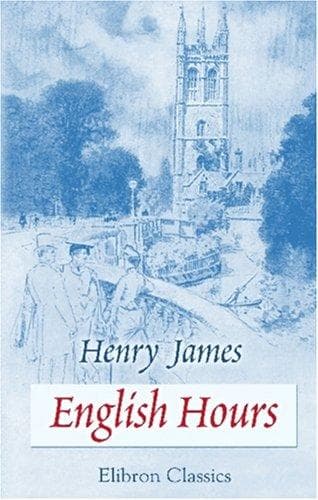
England -- Description and travel; James, Henry, 1843-1916 -- Travel -- England
I mention these things as some of the light notes, but the picture
is never too empty for a stronger one not to sound. The strongest, at
Dunwich, is indeed one that, without in the least falsifying the scale,
counts immensely for filling in. The palm in the rustic sports is for
the bluejackets; as, in England, of course, nothing is easier than for
the village green to alternate with the element that Britannia still
more admirably rules. I had often dreamed that the ideal refuge for a
man of letters was a cottage so placed on the coast as to be circled,
as it were, by the protecting arm of the Admiralty. I remember to
have heard it said in the old country—in New York and Boston—that the
best place to live in is next to an engine-house, and it is on this
analogy that, at Dunwich, I have looked for ministering peace in near
neighbourhood to one of those stations of the coast-guard that, round
all the edge of England, at short intervals, on rock and sand and
heath, make, with shining whitewash and tar, clean as a great state is
at least theoretically clean, each its own little image of the reach
of the empire. It is in each case an image that, for one reason and
another, you respond to with a sort of thrill; and the thing becomes
as concrete as you can wish on your discovering in the three or four
individual members of the simple staff of the establishment all sorts
of educated decency and many sorts of beguilement to intercourse. Prime
among the latter, in truth, is the great yarn-spinning gift. It differs
from man to man, but here and there it glows like a cut ruby. May the
last darkness close before I cease to care for sea-folk!—though this,
I hasten to add, is not the private predilection at which, in these
incoherent notes, I proposed most to glance. Let me have mentioned it
merely as a sign that the fault is all my own if, this summer, the arm
of the Admiralty has not, in the full measure of my theory, represented
the protection under which the long literary morning may know—abyss of
delusion!—nothing but itself.
DUNWICH, August 31, 1879.
[Illustration]
INDEX
Abergavenny, 247.
“Adam Bede,” locality of, 216, 217.
Aldeburgh, birthplace of Crabbe, 323, 324.
Apsley House, 20, 21.
Arnold, Matthew, 24;
“The Sick King in Bokhara,” quoted, 29.
Avon River, 90.
Baillie, Joanna, 44.
Banbury, 218.
Becket, Thomas A’, his assassination at Canterbury, 149, 150;
his shrine, 150, 151.
Belgravia, 15, 16; in dog-days, 154.
Blackheath, the Common, 168.
Black Prince, the (_see_ Edward Plantagenet).
Blunderstone, 318, 319.
Bonchurch, 253, 254.
Brighton, 278;
gaiety of, 279.
Broughton Castle, 219, 220.
Browning, Robert, 51-59.
Buckingham Palace, 21, 23.
Bury St. Edmunds, 266;
ruined abbey at, 267.
Cambridge University, famous chapel of King’s College, 264, 265.
Public-domain text, read in full here on John Shaqi.
Reviews
Reviews
No reviews yet
Be the first to share your thoughts on this work.
Elsewhere in the archive
Join the Discussion
Join the discussion
Sign in to leave a comment or review.
Sign InorCreate an account