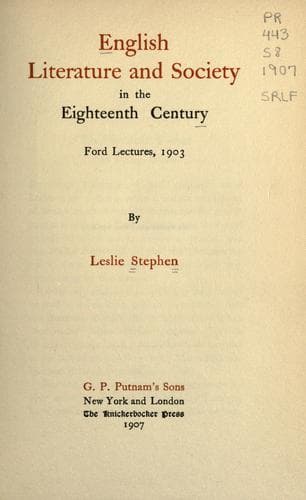
English Literature and Society in the Eighteenth CenturyStephen, Leslie
History
English Literature and Society in the Eighteenth Century
Stephen, Leslie
England -- Social life and customs -- 18th century; English literature -- 18th century -- History and criticism
Now let us pass to the literary manifestation of this order. The
literary society, as it existed under Queen Anne, had been broken up;
two or three of the men who had already made their mark continued their
activity, especially Pope and Swift. Swift, however, was living apart
from the world, though he was still to come to the front on more than
one remarkable occasion. Pope, meanwhile, became the acknowledged
dictator. The literary movement may be called after Pope, as distinctly
as the political after Walpole. He established his dynasty so thoroughly
that in later days the attempt to upset him was regarded as a daring
revolution. What was Pope? Poet or not, for his title to the name has
been disputed, he had one power or weakness in which he has scarcely
been rivalled. No writer, that is, reflects so clearly and completely
the spirit of his own day. His want of originality means the extreme and
even morbid sensibility which enabled him to give the fullest utterance
to the ideas of his class, and of the nation, so far as the nation was
really represented by the class. But the literary class was going
through a process of differentiation, as the alliance of authors and
statesmen broke up. Pope represents mainly the aristocratic movement. He
had become independent--a fact of which he was a little too proud--and
moved on the most familiar terms with the great men of the age. The Tory
leaders were, of course, his special friends; but in later days he
became a friend of Frederick, Prince of Wales, and of the politicians
who broke off from Walpole; while even with Walpole he was on terms of
civility. His poems give a long catalogue of the great men of whose
intimacy he was so proud. Besides Bolingbroke, his 'guide, philosopher,
and friend,' he counts up nearly all the great men of his time. Somers
and Halifax, and Granville and Congreve, Oxford and Atterbury, who had
encouraged his first efforts; Pulteney, Chesterfield, Argyll, Wyndham,
Cobham, Bathurst, Peterborough, Queensberry, who had become friends in
later years, receive the delicate compliments which imply his excusable
pride in their alliance. Pope, therefore, may be considered from one
point of view as the authorised interpreter of the upper circle, which
then took itself to embody the highest cultivation of the nation. We may
appreciate Pope's poetry by comparing it with an independent
manifestation of their morality. The most explicit summary of the
general tone of the class-morality may, I think, be gathered from
Chesterfield's _Letters_. Though written at a later period, they sum up
the lesson he has imbibed from his experience at this time. Chesterfield
was no mere fribble or rake. He was a singularly shrewd, impartial
observer of life, who had studied men at first hand as well as from
books. His letters deal with the problem: What are the conditions of
success in public life? He treats it in the method of Machiavelli; that
Public-domain text, read in full here on John Shaqi.
Reviews
Reviews
No reviews yet
Be the first to share your thoughts on this work.
Elsewhere in the archive
Join the Discussion
Join the discussion
Sign in to leave a comment or review.
Sign InorCreate an account