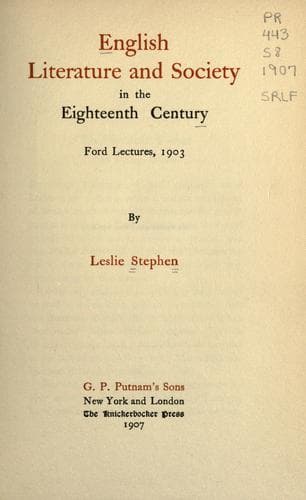
English Literature and Society in the Eighteenth CenturyStephen, Leslie
History
English Literature and Society in the Eighteenth Century
Stephen, Leslie
England -- Social life and customs -- 18th century; English literature -- 18th century -- History and criticism
appeals to the soul, and is not built upon syllogisms or allowed to
depend upon the result of historical criticism. This view, I need hardly
say, is opposed to the whole rationalist theory, whether of the deist or
the orthodox variety: it was so opposed that it could find scarcely any
sympathy at the time; and for that reason it indicates one
characteristic of the contemporary thought. To omit the mystical element
is to be cold and unsatisfactory in religious philosophy, and to be
radically prosaic and unpoetical in the sphere of literature. Englishmen
could never become mystics in the technical sense, but they were
beginning to be discontented with the bare logical system of the
religion of nature. They were ready for some utterance of the emotional
and imaginative element in religion and philosophy which was left out of
account by the wits and rationalists. I do not myself believe that the
intellectual weakness of abstract deism gives a sufficient explanation
of its decay. In fact, as accepted by Rousseau and by some of his
English followers, it could ally itself with the ardent revolutionary
enthusiasm which was to be the marked peculiarity of the latter part of
the century. We must add another consideration. Locke and his
contemporaries had laid down political and religious principles which,
if logically developed, would lead to the revolutionary doctrines of
1789. They did not develop them, and mainly, I take it, because the
practical application excited no strong feeling. The spark did not find
fuel ready to be lighted. The political and social conditions supply a
sufficient explanation of the indifference. People were practically
content with the existing order in Church and State. The deist
controversies did not reach the enormous majority of the nation, who
went quietly about their business in the old paths. The orthodox
themselves were so rationalistic in principle that the whole discussion
seemed to turn upon non-essential points. But moreover the Church was so
thoroughly subordinated to the laity; it was so much a part of the
regular comfortable system of things; so little able or inclined to set
up as an independent power claiming special authority and enforcing
discipline, that it excited no hostility. Parson and squire were part of
the regular system which could not be attacked without upsetting the
whole system; and there was as yet no general discontent with that
system, or, indeed, any disposition whatever to reconstruct the
machinery which was working so quietly and so thoroughly in accordance
with the dumb instincts of the overwhelming majority.
Public-domain text, read in full here on John Shaqi.
Reviews
Reviews
No reviews yet
Be the first to share your thoughts on this work.
Elsewhere in the archive
Join the Discussion
Join the discussion
Sign in to leave a comment or review.
Sign InorCreate an account