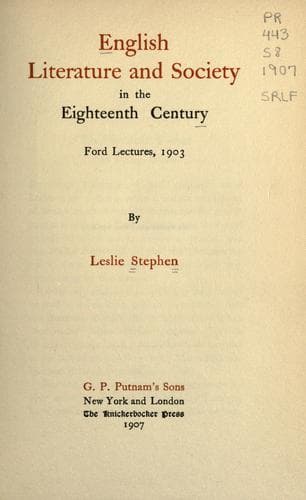
English Literature and Society in the Eighteenth CenturyStephen, Leslie
History
English Literature and Society in the Eighteenth Century
Stephen, Leslie
England -- Social life and customs -- 18th century; English literature -- 18th century -- History and criticism
That
is especially true of women, of whom he always speaks with the true
aristocratic contempt. A man of sense will humour them and flatter them;
he will never consult them seriously, nor really trust them, but he will
make them believe that he does both. They are invaluable as tools,
though contemptible in themselves. This, of course, represents the tone
too characteristic of the epicurean British nobleman. Yet with all this
cynicism, Chesterfield's morality is perfectly genuine in its way. He
has the sense of honour and the patriotic feeling of his class. He has
the good nature which is compatible with, and even congenial to, a
certain cynicism. He is said to have achieved the very unusual success
of being an admirable Lord-Lieutenant of Ireland. In fact he had the
intellectual vigour which implies a real desire for good administration,
less perhaps from purely philanthropic motives than from respect for
efficiency.
'For forms of government let fools contest
Whate'er is best administered, is best,'
says Pope, and that was Chesterfield's view. Like Frederick of Prussia,
whom he admires above all rulers, he might not be over-scrupulous in his
policy, but wishes the machinery for which he is responsible to be in
thoroughly good working order. He most thoroughly sees the folly, if he
does not sufficiently despise the motives, of the lower order of
politicians to whom bribery and corruption represented the only
political forces worth notice. In practice he might be forced to use
such men, but he sees them to be contemptible, and appreciates the
mischiefs resulting from their rule.
The development of this morality in the aristocratic class, which was
still predominant although the growing importance of the House of
Commons was tending to shift the centre of political gravity to a lower
point, is, I think, sufficiently intelligible to be taken for granted.
Pope, I have said, represents the literary version. The problem, then,
is how this view of life is to be embodied in poetry. One answer is the
_Essay on Man_, in which Pope versified the deism which he learned from
Bolingbroke, and which was characteristic of the upper circle
generally. I need not speak of its shortcomings; didactic poetry of that
kind is dreary enough, and the smart couplets often offend one's taste.
I may say that here and there Pope manages to be really impressive, and
to utter sentiments which really ennobled the deist creed; the aversion
to narrow superstition; to the bigotry which 'dealt damnation round the
land'; and the conviction that the true religion must correspond to a
cosmopolitan humanity. I remember hearing Carlyle quote with admiration
the Universal Prayer--
'Father of all, in every age,
In every clime adored,
By Saint, by Savage, and by Sage,
Jehovah, Jove, or Lord,'
Public-domain text, read in full here on John Shaqi.
Reviews
Reviews
No reviews yet
Be the first to share your thoughts on this work.
Elsewhere in the archive
Join the Discussion
Join the discussion
Sign in to leave a comment or review.
Sign InorCreate an account