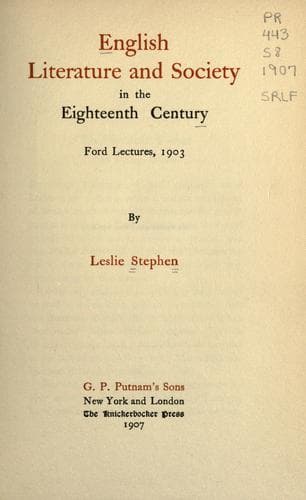
English Literature and Society in the Eighteenth CenturyStephen, Leslie
History
English Literature and Society in the Eighteenth Century
Stephen, Leslie
England -- Social life and customs -- 18th century; English literature -- 18th century -- History and criticism
and it is the worthy utterance of one good legacy which the deist
bequeathed to posterity. Pope himself was alarmed when he discovered
that he had slipped unawares into heterodoxy. His creed was not
congenial to the average mind, though it was to that of his immediate
circle. Meanwhile, his most characteristic and successful work was of a
different order. The answer, in fact, to the problem which I have just
stated, is that the only kind of poetry that was congenial to his
environment was satire--if satire can be called poetry. Pope's satires,
the 'Epistle to Arbuthnot,' the 'Epilogue,' and some of the 'Imitations
of Horace,' represent his best and most lasting achievement. There he
gives the fullest expression to the general sentiment in the most
appropriate form. His singular command of language, and, within his own
limits, of versification, was turned to account by conscientious and
unceasing labour in polishing his style. Particular passages, like the
famous satire upon Addison, have been slowly elaborated; he has brooded
over them for years; and, if the result of such methods is sometimes a
mosaic rather than a continuous current of discourse, the extraordinary
brilliance of some passages has made them permanently interesting and
enriched our literature with many proverbial phrases. The art was
naturally cultivated and its results appreciated in the circle formed by
such men as Congreve, Bolingbroke, and Chesterfield and the like, by
whom witty conversation was cultivated as a fine art. Chesterfield tells
us that he never spoke without trying to express himself as well as
possible; and Pope carries out the principle in his poetry. The thorough
polish has preserved the numerous phrases, still familiar, which have
survived the general neglect of his work. Pope indeed manages to
introduce genuine poetry, as in his famous compliments or his passage
about his mother, in which we feel that he is really speaking from his
heart. But no doubt Atterbury gave him judicious (if not very Christian)
advice, when he told him to stick to the vein of the Addison verses. The
main topic of the satires is a denunciation of an age when, as he puts
it,
'Not to be corrupted is the shame.'
Public-domain text, read in full here on John Shaqi.
Reviews
Reviews
No reviews yet
Be the first to share your thoughts on this work.
Elsewhere in the archive
Join the Discussion
Join the discussion
Sign in to leave a comment or review.
Sign InorCreate an account