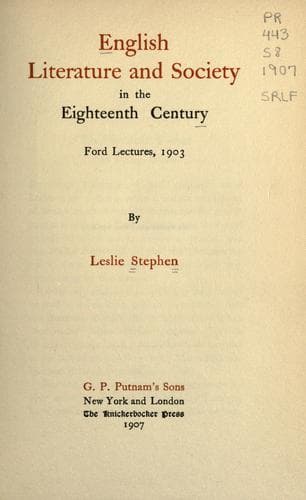
English Literature and Society in the Eighteenth CenturyStephen, Leslie
History
English Literature and Society in the Eighteenth Century
Stephen, Leslie
England -- Social life and customs -- 18th century; English literature -- 18th century -- History and criticism
He ascribes his own indignation to the 'strong antipathy of good to
bad,' which is a satisfactory explanation to himself. But he was still
interpreting the general sentiment and expressing the general discontent
caused by the Walpole system. His friends, Bolingbroke and Wyndham, and
the whole opposition, partially recruited from Walpole's supporters,
were insisting upon the same theme. If, as I have said, some of them
were really sincere in recognising the evil, and, like Bolingbroke in
the _Patriot King_, trying to ascertain its source--we are troubled in
this even by the doubt as to whether they objected to corruption or only
to the corrupt influence of their antagonists. But Pope, as a poet,
living outside the political circle, can take the denunciations quite
seriously and be not only pointed but really dignified. He sincerely
believes that vice can be seriously discouraged by lashing at it with
epigrams. So far, he represented a general feeling of the literary
class, explained in various ways by such men as Thomson, Fielding,
Glover, and Johnson, who were, from very different points of view, in
opposition to Walpole. Satire can only flourish under some such
conditions as then existed. It supposes, among other things, the
existence of a small cultivated class, which will fully appreciate the
personalities, the dexterity of insinuation, and the cutting sarcasm
which gives the spice to much of Pope's satire. Young, a singularly
clever writer, was eclipsed by Pope because he kept to denoting general
types and was not intimate with the actors on the social stage. Johnson,
still more of an outsider, wrote a most effective and sonorous poem with
the help of Juvenal; but it becomes a moral disquisition upon human
nature which has not the special sting and sparkle of Pope. No later
satirist has approached Pope, and the art has now become obsolete, or is
adopted merely as a literary amusement. One obvious reason is the
absence of the peculiar social backing which composed Pope's audience
and supplied him with his readers.
Public-domain text, read in full here on John Shaqi.
Reviews
Reviews
No reviews yet
Be the first to share your thoughts on this work.
Elsewhere in the archive
Join the Discussion
Join the discussion
Sign in to leave a comment or review.
Sign InorCreate an account