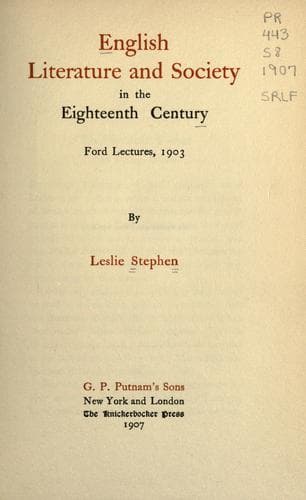
English Literature and Society in the Eighteenth CenturyStephen, Leslie
History
English Literature and Society in the Eighteenth Century
Stephen, Leslie
England -- Social life and customs -- 18th century; English literature -- 18th century -- History and criticism
It was, however, at the period of which I am
speaking that a change was taking place which was worth considering.
One cause is obvious. The Wit utters the voice of the town. He agreed
with the gentleman who preferred the smell of a flambeau in St. James
Street to any abundance of violet and sweetbriar. But, as communications
improved between town and country, the separation between the taste of
classes became less marked. The great nobleman had always been in part
an exalted squire, and had a taste for field-sports as well as for the
opera. Bolingbroke and Walpole are both instances in point. Sir Roger de
Coverley came up to town more frequently than his ancestors, but the
_Spectator_ recorded his visits as those of a simple rustic. After the
peace, the country gentleman begins regularly to visit the Continent.
The 'grand tour' mostly common in the preceding century becomes a normal
fact of the education of the upper classes. The foundation of the
Dilettante Club in 1734 marks the change. The qualifications, says
Horace Walpole, were drunkenness and a visit to Italy. The founders of
it seem to have been jovial young men who had met each other abroad,
where, with obsequious tutors and out of sight of domestic authority,
they often learned some very queer lessons. But many of them learned
more, and by degrees the Dilettante Club took not only to encouraging
the opera in England, but to making really valuable archaeological
researches in Greece and elsewhere. The intelligent youth had great
opportunities of mixing in the best foreign society, and began to bring
home the pictures which adorn so many English country houses; to talk
about the 'correggiosity of Correggio'; and in due time to patronise
Reynolds and Gainsborough. The traveller began to take some interest
even in the Alps, wrote stanzas to the 'Grande Chartreuse,' admired
Salvator Rosa, and even visited Chamonix. Another characteristic change
is more to the present purpose. A conspicuous mark of the time was a
growing taste for gardening. The taste has, I suppose, existed ever
since our ancestors were turned out of the Garden of Eden. Milton's
description of that place of residence, and Bacon's famous essay, and
Cowley's poems addressed to the great authority Evelyn, and most of all
perhaps Maxwell's inimitable description of the very essence of garden,
may remind us that it flourished in the seventeenth century. It is
needless to say in Oxford how beautiful an old-fashioned garden might
be. But at this time a change was taking place in the canons of taste.
Temple in a well-known essay had praised the old-fashioned garden and
had remarked how the regularity of English plantations seemed ridiculous
to--of all people in the world--the Chinese. By the middle of the
eighteenth century there had been what is called a 'reaction,' and the
English garden, which was called 'natural,' was famous and often
imitated in France. It is curious to remark how closely this taste was
Public-domain text, read in full here on John Shaqi.
Reviews
Reviews
No reviews yet
Be the first to share your thoughts on this work.
Elsewhere in the archive
Join the Discussion
Join the discussion
Sign in to leave a comment or review.
Sign InorCreate an account