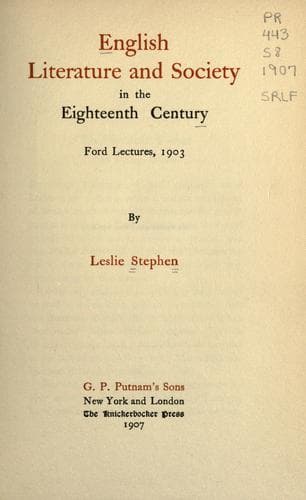
English Literature and Society in the Eighteenth CenturyStephen, Leslie
History
English Literature and Society in the Eighteenth Century
Stephen, Leslie
England -- Social life and customs -- 18th century; English literature -- 18th century -- History and criticism
associated with the group of friends whom Pope has celebrated. The
first, for example, of the four 'Moral Epistles,' is addressed to
Cobham, who laid out the famous garden at Stowe, in which 'Capability
Brown,' the most popular landscape gardener of the century, was brought
up; the third is addressed to Bathurst, an enthusiastic gardener, who
had shown his skill at his seat of Richings near Colnbrook; and the
fourth to Burlington, whose house and gardens at Chiswick were laid out
by Kent, the famous landscape gardener and architect--Brown's
predecessor. In the same epistle Pope ridicules the formality of
Chandos' grounds at Canons. A description of his own garden includes the
familiar lines
'Here St. John mingles with my friendly bowl
The feast of reason and the flow of soul,
And he (Peterborough) whose lightning pierced the Iberian lines
Now forms my quincunx and now ranks my vines,
Or tames the genius of the stubborn plain
Almost as quickly as he conquered Spain.'
Pope's own garden was itself a model. 'Pope,' says Horace Walpole, 'had
twisted and twirled and rhymed and harmonised his little five acres
till it appeared two or three sweet little lawns opening and opening
beyond one another, and the whole surrounded with thick impenetrable
woods.' The taste grew as the century advanced. Now one impulse towards
the new style is said to have come from articles in the _Spectator_ by
Addison and in the _Guardian_ by Pope, ridiculing the old-fashioned mode
of clipping trees, and so forth. Nature, say both, is superior to art,
and the man of genius, as Pope puts it, is the first to perceive that
all art consists of 'imitation and study of nature.' Horace Walpole in
his essay upon gardening remarks a point which may symbolise the
principle. The modern style, he says, sprang from the invention of the
ha-ha by Bridgeman, one of the first landscape gardeners. The 'ha-ha'
meant that the garden, instead of being enclosed by a wall, was laid out
so as to harmonise with the surrounding country, from which it was only
separated by an invisible fence. That is the answer to the problem; is
it not a solecism for a lover of gardens to prefer nature to art? A
garden is essentially a product of art? and supplants the moor and
desert made by unassisted nature. The love of Nature as understood in a
later period, by Byron for example, went to this extreme, in words at
least, and becomes misanthropical in admiring the savage for its own
sake. But the landscape gardener only meant that his art must be in some
sense subordinate to nature; that he must not shut out the wider scenery
but include it in his designs. He was apt to look upon mountains as a
background to parks, as Telford thought that rivers were created to
supply canals. The excellent Gilpin, who became an expounder of what he
calls 'the theory of the picturesque,' travelled on the Wye in the same
year as Gray; and amusingly criticises nature from this point of view.
Public-domain text, read in full here on John Shaqi.
Reviews
Reviews
No reviews yet
Be the first to share your thoughts on this work.
Elsewhere in the archive
Join the Discussion
Join the discussion
Sign in to leave a comment or review.
Sign InorCreate an account