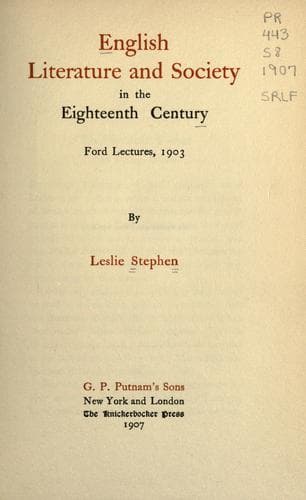
English Literature and Society in the Eighteenth CenturyStephen, Leslie
History
English Literature and Society in the Eighteenth Century
Stephen, Leslie
England -- Social life and customs -- 18th century; English literature -- 18th century -- History and criticism
Nature, he says, works in a cold and singular style of composition, but
has the merit of never falling into 'mannerism.' Nature, that is, is a
sublime landscape gardener whose work has to be accepted, and to whom
the gardener must accommodate himself. A quaint instance of this theory
may be found in the lecture which Henry Tilney in _Mansfield Park_
delivers to Catherine Morland. In Horace Walpole's theory, the evolution
of the ha-ha, means that man and nature, the landowner and the country,
are gradually forming an alliance, and it comes to the same thing
whether one or the other assimilates his opposite.
Briefly, this means one process by which the so-called love of nature
was growing; it meant better roads and inns; the gradual reflux of town
into country; and the growing sense already expressed by Cowley and
Marvell, that overcrowded centres of population have their
inconveniences, and that the citizen should have his periods of
communion with unsophisticated nature. Squire and Wit are each learning
to appreciate each other's tastes. The tourist is developed, and begins,
as Gibbon tells us, to 'view the glaciers' now that he can view them
without personal inconvenience. This, again, suggests that there is
nothing radically new in the so-called love of nature. Any number of
poets from Chaucer downwards may be cited to show that men were never
insensible to natural beauty of scenery; to the outburst of spring, or
the bloom of flowers, or the splendours of storms and sunsets. The
indifference to nature of the Pope school was, so far, the temporary
complacency of the new population focused in the metropolitan area in
their own enlightenment and their contempt for the outside rustic. The
love of field-sports was as strong as ever in the squire, and as soon as
he began to receive some of the intellectual irradiation from the town
Wit, he began to express the emotions which never found clearer
utterance than in Walton's _Compleat Angler_. But there is a
characteristic difference. With the old poets nature is in the
background; it supplies the scenery for human action and is not itself
consciously the object; they deal with concrete facts, with the delight
of sport or rustic amusements: and they embody their feelings in the old
conventions; they converse with imaginary shepherds: with Robin Hood or
allegorical knights in romantic forests, who represent a love of nature
but introduce description only as a set-off to the actors in masques or
festivals. In Pope's time we have the abstract or metaphysical deity
Nature, who can be worshipped with a distinct appreciation. The
conventions have become obsolete, and if used at all, the poet himself
is laughing in his sleeve. The serious aim of the poet is to give a
philosophy of human nature; and the mere description of natural objects
strikes him as silly unless tacked to a moral. Who could take offence,
asks Pope, referring to his earlier poems, 'when pure description held
Public-domain text, read in full here on John Shaqi.
Reviews
Reviews
No reviews yet
Be the first to share your thoughts on this work.
Elsewhere in the archive
Join the Discussion
Join the discussion
Sign in to leave a comment or review.
Sign InorCreate an account