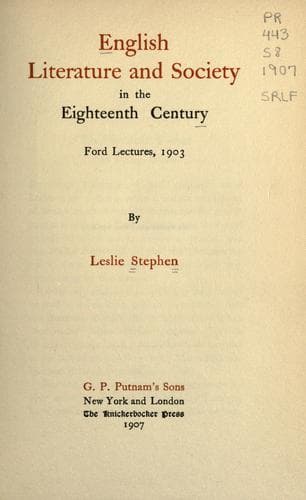
English Literature and Society in the Eighteenth CenturyStephen, Leslie
History
English Literature and Society in the Eighteenth Century
Stephen, Leslie
England -- Social life and customs -- 18th century; English literature -- 18th century -- History and criticism
I am now to speak of the quarter of a century which succeeded the fall
of Walpole, and includes two singularly contrasted periods. Walpole's
fall meant the accession to power of the heterogeneous body of statesmen
whose virtuous indignation had been raised by his corrupt practices.
Some of them, as Carteret, Pulteney, Chesterfield, were men of great
ability; but, after a series of shifting combinations and personal
intrigues, the final result was the triumph of the Pelhams--the
grotesque Duke of Newcastle and his brother, who owed their success
mainly to skill in the art of parliamentary management. The opposition
had ousted Walpole by taking advantage of the dumb instinct which
impelled us to go to war with Spain; and distracted by the interests of
Hanover and the balance of power we had plunged into that complicated
series of wars which lasted for some ten years, and passes all powers
of the ordinary human intellect to understand or remember. For what
particular reason Englishmen were fighting at Dettingen or Fontenoy or
Lauffeld is a question which a man can only answer when he has been
specially crammed for examination and his knowledge has not begun to
ooze out; while the abnormal incapacity of our rulers was displayed at
the attack upon Carthagena or during the Pretender's march into England.
The history becomes a shifting chaos marked by no definite policy, and
the ship of State is being steered at random as one or other of the
competitors for rule manages to grasp the helm for a moment. Then after
another period of aimless intrigues the nation seems to rouse itself;
and finding at last a statesman who has a distinct purpose and can
appeal to a great patriotic sentiment, takes the leading part in Europe,
wins a series of victories, and lays the foundation of the British
Empire in America and India. Under Walpole's rule the House of Commons
had become definitely the dominant political body. The minister who
could command it was master of the position. The higher aristocracy are
still in possession of great influence, but they are ceasing to be the
adequate representatives of the great political forces. They are in the
comfortable position of having completely established their own
privileges; and do not see any reason for extending privileges to
others. Success depends upon personal intrigues among themselves and
upon a proper manipulation of the Lower House which, though no overt
constitutional change has taken place, is coming to be more decidedly
influenced by the interests of the moneyed men and the growing middle
classes. Pitt and Newcastle represent the two classes which are coming
into distinct antagonism. Pitt's power rested upon the general national
sentiment. 'You have taught me,' as George II. said to him, 'to look for
the sense of my people in other places than the House of Commons.' The
House of Commons, that is, should not derive its whole authority from
the selfish interest of the borough-mongers but from the great outside
Public-domain text, read in full here on John Shaqi.
Reviews
Reviews
No reviews yet
Be the first to share your thoughts on this work.
Elsewhere in the archive
Join the Discussion
Join the discussion
Sign in to leave a comment or review.
Sign InorCreate an account