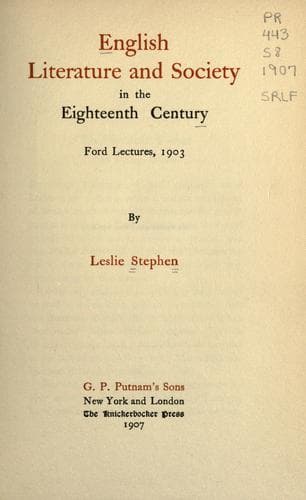
English Literature and Society in the Eighteenth CenturyStephen, Leslie
History
English Literature and Society in the Eighteenth Century
Stephen, Leslie
England -- Social life and customs -- 18th century; English literature -- 18th century -- History and criticism
These symptoms indicate the tendencies of the rising class to which the
author has mainly to address himself. It has ceased to be fully
represented by the upper social stratum whose tastes are reflected by
Pope. No distinct democratic sentiment had yet appeared; the
aristocratic order was accepted as inevitable or natural; but there was
a vague though growing sentiment that the rulers are selfish and
corrupt. There is no strong sceptical or anti-religious sentiment; but a
spreading conviction that the official pastors are scandalously careless
in supplying the wants of their flocks. The philosophical and literary
canons of the scholar and gentleman have become unsatisfactory; the
vulgar do not care for the delicate finish appreciated by your
Chesterfield and acquired in the conversations of polite society, and
the indolent scepticism which leads to metaphysical expositions, and is
not allied with any political or social passion, does not appeal to
them. The popular books of the preceding generation had been the
directly religious books: Baxter's _Saint's Rest_, and the _Pilgrim's
Progress_--despised by the polite but beloved by the popular class in
spite of the critics; and among the dissenters such a work as Boston's
_Fourfold State_, or in the Church, Law's _Serious Call_. Your polite
author had ignored the devil, and he plays a part in human affairs
which, as Carlyle pointed out in later days, cannot be permanently
overlooked. The old horned and hoofed devil, indeed, for whom Defoe had
still a weakness, shown in his _History of the Devil_, was becoming a
little incredible; witchcraft was dying out, though Wesley still felt
bound to profess some belief in it; and the old Calvinistic dogmatism,
though it could produce a certain amount of controversy among the
Methodists, had been made obsolete by the growth of rationalism. Still
the new public wanted something more savoury than its elegant teachers
had given; and, if sermons had ceased to be so stimulating as of old, it
could find it in secular moralisers. Defoe, always keenly alive to the
general taste, had tried to supply the demand not only by his queer
_History of the Devil_ but by appending a set of moral reflections to
_Robinson Crusoe_ and other edifying works, which disgusted Charles Lamb
by their petty tradesman morality, and which hardly represent a very
lofty ideal. But the recognised representative of the moralists was the
ponderous Samuel Johnson. It is hard when reading the _Rambler_ to
recognise the massive common sense and deep feeling struggling with the
ponderous verbiage and elephantine facetiousness; yet it was not only a
treasure of wisdom to the learned ladies, Mrs. Chapone, and Mrs.
Elizabeth Carter and the like, who were now beginning to appear, but was
received, without provoking ridicule, by the whole literary class.
_Rasselas_, in spite of its formality, is still a very impressive book.
The literary critic may amuse himself with the question how Johnson came
Public-domain text, read in full here on John Shaqi.
Reviews
Reviews
No reviews yet
Be the first to share your thoughts on this work.
Elsewhere in the archive
Join the Discussion
Join the discussion
Sign in to leave a comment or review.
Sign InorCreate an account