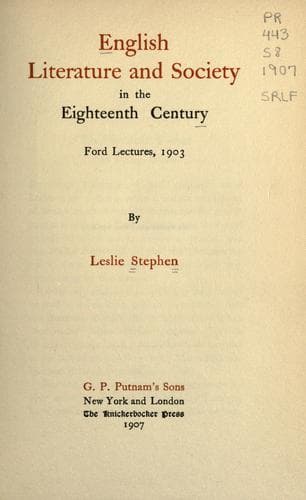
English Literature and Society in the Eighteenth CenturyStephen, Leslie
History
English Literature and Society in the Eighteenth Century
Stephen, Leslie
England -- Social life and customs -- 18th century; English literature -- 18th century -- History and criticism
writes a book which makes a mark not only in England but in Europe, and
is imitated by Rousseau in the book which set more than one generation
weeping; _Clarissa Harlowe_, moreover, was accepted as the masterpiece
of its kind, and she moved not only Englishmen but Germans and Frenchmen
to sympathetic tears. One explanation is that Richardson is regarded as
the inventor of 'sentimentalism.' The word, as one of his correspondents
tells him, was a novelty about 1749, and was then supposed to include
anything that was clever and agreeable. I do not myself believe that
anybody invented the mode of feeling; but it is true that Richardson was
the first writer who definitely turned it to account for a new literary
genus. Sentimentalism, I suppose, means, roughly speaking, indulgence in
emotion for its own sake. The sentimentalist does not weep because
painful thoughts are forced upon him but because he finds weeping
pleasant in itself. He appreciates the 'luxury of grief.' (The phrase is
used in Brown's _Barbarossa_; I don't know who invented it.) Certainly
the discovery was not new. The charms of melancholy had been recognised
by Jaques in the forest of Arden and sung by various later poets; but
sentimentalism at the earlier period naturally took the form of
religious meditation upon death and judgment. Young and Hervey are
religious sentimentalists, who have also an eye to literary elegance.
Wesley was far too masculine and sensible to be a sentimentalist; his
emotions impel him to vigorous action; and are much too serious to be
cultivated for their own sakes or to be treated aesthetically. But the
general sense that something is not in order in the general state of
things, without as yet any definite aim for the vague discontent, was
shared by the true sentimentalist. Richardson's sentimentalism is partly
unconscious. He is a moralist very much in earnest, preaching a very
practical and not very exalted morality. It is his moral purpose, his
insistence upon the edifying point of view, his singular fertility in
finding illustrations for his doctrines, which makes him a
sentimentalist. I will confess that the last time I read _Clarissa
Harlowe_ it affected me with a kind of disgust. We wonder sometimes at
the coarse nerves of our ancestors, who could see on the stage any
quantity of murders and ghosts and miscellaneous horrors. Richardson
gave me the same shock from the elaborate detail in which he tells the
story of Clarissa; rubbing our noses, if I may say so, in all her
agony, and squeezing the last drop of bitterness out of every incident.
I should have liked some symptom that he was anxious to turn his eyes
from the tragedy instead of giving it so minutely as to suggest that he
enjoys the spectacle. Books sometimes owe part of their success, as I
fear we must admit, to the very fact that they are in bad taste. They
attract the contemporary audience by exaggerating and over-weighting the
new vein of sentiment which they have discovered.
Public-domain text, read in full here on John Shaqi.
Reviews
Reviews
No reviews yet
Be the first to share your thoughts on this work.
Elsewhere in the archive
Join the Discussion
Join the discussion
Sign in to leave a comment or review.
Sign InorCreate an account