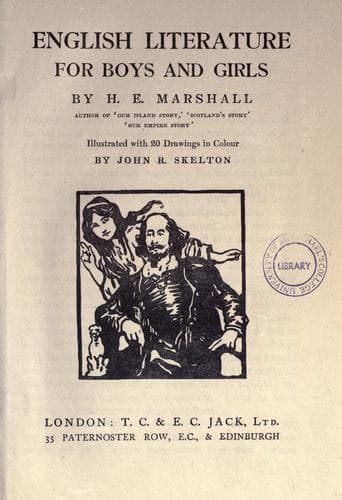
English Literature for Boys and GirlsMarshall, H. E. (Henrietta Elizabeth)
History
English Literature for Boys and Girls
Marshall, H. E. (Henrietta Elizabeth)
English literature -- History and criticism
The members of each guild tried to make their pageant as fine as
they could. Indeed, they were expected to do so, for in 1394 we
find the Mayor of York ordering the craftsmen "to bring forth
their pageants in order and course by good players, well arrayed
and openly speaking, upon pain of losing of 100 shillings, to be
paid to the chamber without any pardon."*
*Thomas Sharp, Dissertation on the Pageants.
So, in order to supply everything that was needful, each member
of a guild paid what was called "pageant silver." Accounts of
how this money was spent were carefully kept. A few of these
have come down to us, and some of the items and prices paid sound
very funny now.
"Paid for setting the world of fire 5d.
For making and mending of the black souls hose 6d.
For a pair of new hose and mending of the old for the white souls 18d.
Paid for mending Pilate's hat 4d."
The actors, too, were paid. Here are some of the prices:--
"To Fawson for hanging Judas 4d.
Paid to Fawson for cock crowing 4d.
Some got much more than others. Pilate, for instance, who was an
important character, got 4s., while two angels only got 8d.
between them. But while the rehearsing and acting were going on
the players received their food, and when it was all over they
wound up with a great supper.
Chapter XXXIII HOW THE SHEPHERDS WATCHED THEIR FLOCKS
IN this chapter I am going to give you a part of one of the
Townley plays to show you what the beginnings of our drama were
like,
Although our forefathers tried to make the pageants as real as
possible, they had, of course, no scenery, but acted on a little
bare platform. They never thought either that the stories they
acted had taken place long ago and in lands far away, where dress
and manners and even climate were all very different from what
they were in England.
For instance, in the Shepherd's play, of which I am going to
tell, the first shepherd comes in shivering with cold. For
though he is acting in summer he must make believe that it is
Christmas-time, for on Christmas Day Christ was born. And
Christmas-time in England, he knows, is cold. What it may be in
far-off Palestine he neither knows nor cares.
"Lord, what these weathers are cold! and I am ill happed;
I am near hand dulled so long have I napped;
My legs they fold, my fingers are chapped,
It is not as I would, for I am all lapped
In sorrow.
In storm and tempest,
Now in the east, now in the west,
Woe is him has never rest
Mid-day or morrow."
In this strain the shepherd grumbles until the second comes. He,
too, complains of the cold.
"The frost so hideous, they water mine een,
No lie!
Now is dry, now is wet,
Now is snow, now is sleet,
When my shoon freeze to my feet,
It is not all easy."
So they talk until the third shepherd comes. He, too, grumbles.
Public-domain text, read in full here on John Shaqi.
Reviews
Reviews
No reviews yet
Be the first to share your thoughts on this work.
Elsewhere in the archive
Join the Discussion
Join the discussion
Sign in to leave a comment or review.
Sign InorCreate an account