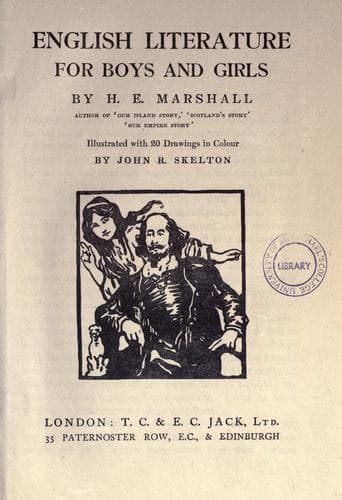
English Literature for Boys and GirlsMarshall, H. E. (Henrietta Elizabeth)
History
English Literature for Boys and Girls
Marshall, H. E. (Henrietta Elizabeth)
English literature -- History and criticism
SPENSER'S plan for the Faery Queen was a very great one. He
meant to write a poem in twelve books, each book containing the
adventures of a knight who was to show forth one virtue. And if
these were well received he purposed to write twelve more. Only
the first three books were as yet published, but they made him
far more famous than the Shepherd's Calendar had done. For never
since Chaucer had such poetry been written. In the Faery Queen
Spenser has, as he says, changed his "oaten reed" for "trumpets
stern," and sings no longer now of shepherds and their loves, but
of "knights and ladies gentle deeds" of "fierce wars and faithful
loves."
The first three books tell the adventures of the Red Cross Knight
St. George, or Holiness; of Sir Guyon, or Temperance; and of the
Lady Britomartis, or Chastity. The whole poem is an allegory.
Everywhere we are meant to see a hidden meaning. But sometimes
the allegory is very confused and hard to follow. So at first,
in any case, it is best to enjoy the story and the beautiful
poetry, and not trouble about the second meaning. Spenser
plunges us at once into the very middle of the story. He begins:
"A gentle Knight was pricking on the plain,
Yelad in mighty arms and silver shield,
Wherein old dints of deep wounds did remain,
The cruel marks of many a bloody field;
Yet arms till that time did he never wield.
His angry steed did chide his foaming bit,
As much disdaining to the curb to yield:
Full jolly knight he seem'd, and fair did sit,
As one for knightly jousts and fierce encounters fit.
But on his breast a bloody cross he bore,
The dear remembrance of his dying Lord,
For whose sweet sake that glorious badge he wore,
And dead as living ever him ador'd;
Upon his shield the like was also scor'd."
And by the side of this Knight rode a lovely Lady upon a snow-
white ass. Her dress, too, was snow-white, but over it she wore
a black cloak, "as one that inly mourned," and it "seemed in her
heart some hidden care she had."
So the story begins; but why these two, the grave and gallant
Knight and the sad and lovely Lady, are riding forth together we
should not know until the middle of the seventh canto, were it
not for a letter which Spenser wrote to Raleigh and printed in
the beginning of his book. In it he tells us not only who these
two are, but also his whole great design. He writes this letter,
he says, "knowing how doubtfully all allegories may be
construed," and this book of his "being a continued allegory, or
dark conceit," he thought it good to explain. Having told how he
means to write of twenty-four knights who shall represent twenty-
four virtues, he goes on to tell us that the Faery Queen kept her
yearly feast twelve days, upon which twelve days the occasions of
the first twelve adventures happened, which, being undertaken by
twelve knights, are told of in these twelve books.
Public-domain text, read in full here on John Shaqi.
Reviews
Reviews
No reviews yet
Be the first to share your thoughts on this work.
Elsewhere in the archive
Join the Discussion
Join the discussion
Sign in to leave a comment or review.
Sign InorCreate an account