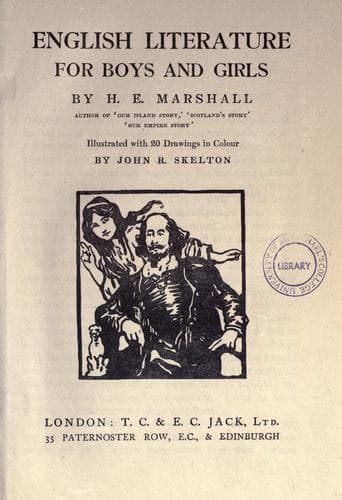
English Literature for Boys and GirlsMarshall, H. E. (Henrietta Elizabeth)
History
English Literature for Boys and Girls
Marshall, H. E. (Henrietta Elizabeth)
English literature -- History and criticism
Then, too, plays began to be divided into tragedies and comedies.
A tragedy is a play which shows the sad side of life and which
has a mournful ending. The word really means a goat-song, and
comes from two Greek words, "tragos" a goat and "ode" a song. It
was so called either because the oldest tragedies were acted
while a goat was sacrificed, or because the actors themselves
wore clothes made of goat-skins. A comedy is a play which shows
the merry side of life and has a happy ending. This word too
comes from two Greek words, "komos," a revel, and "ode," a song.
The Greek word for village is also "komo," so a comedy may at
first have meant a village revel or a merry-making. "Tragedy,"
it has been said, "is poetry in its deepest earnest; comedy is
poetry in unlimited jest."* But the old Moralities were neither
the one nor the other, neither tragedy nor comedy. They did not
touch life keenly enough to awaken horror or pain. They were
often sad, but not with that sadness which we have come to call
tragic, they were often indeed merely dull, and although there
was always a funny character to make laughter, it was by no means
unlimited jest. The Interludes came next, after the Moralities,
with a little more human interest and a little more fun, and from
them it was easy to pass to real comedies.
*Coleridge.
A play named Ralph Roister Doister is generally looked upon as
the first real English comedy. It was written by Nicholas Udall,
headmaster first of Eton and then of Westminster, for the boys of
one or other school. It was probably for those of Westminster
that it was written, and may have been acted about 1552.
The hero, if one may call him so, who gives his name to the play,
is a vain, silly swaggerer. He thinks every woman who sees him
is in love with him. So he makes up his mind to marry a rich and
beautiful widow named Christian Custance.
Not being a very good scholar, Ralph gets some one else to write
a love-letter for him, but when he copies it he puts all the
stops in the wrong places, which makes the sense quite different
from what he had intended, and instead of being full of pretty
things the letter is full of insults.
Dame Custance will have nothing to say to such a stupid lover, "I
will not be served with a fool in no wise. When I choose a
husband I hope to take a man," she says. In revenge for her
scorn Ralph Roister Doister threatens to burn the dame's house
down, and sets off to attack it with his servants. The widow,
however, meets him with her handmaidens. There is a free fight
(which, no doubt, the schoolboy actors enjoyed), but the widow
gets the best of it, and Ralph is driven off.
Public-domain text, read in full here on John Shaqi.
Reviews
Reviews
No reviews yet
Be the first to share your thoughts on this work.
Elsewhere in the archive
Join the Discussion
Join the discussion
Sign in to leave a comment or review.
Sign InorCreate an account