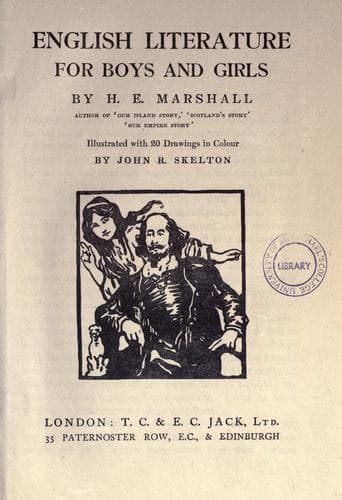
English Literature for Boys and GirlsMarshall, H. E. (Henrietta Elizabeth)
History
English Literature for Boys and Girls
Marshall, H. E. (Henrietta Elizabeth)
English literature -- History and criticism
And so we get a picture of Ben lording it in taverns. A great
good fellow, a stout fellow, he rolls his huge bulk about laying
down the law.
So the years went on. Big Ben wrote and fought, quarreled and
made friends, drank and talked, living always on the verge of
poverty. At length, in 1603, the great Queen Elizabeth died, and
James of Scotland came to the English throne. All the way as he
journeyed he was greeted with rejoicing. There were everywhere
plays and feasts given in his honor, and soon after he arrived in
London a Masque written by Jonson was played before him. The new
king was fond of such entertainments. He smiled upon Master Ben
Jonson, and life became for him easier and brighter.
But shortly after this, Jonson, with two others, wrote a play in
which some things were said against the Scots. With a Scottish
king surrounded by Scottish lords, that was dangerous. All three
soon found themselves in prison and came near losing their noses
and ears. This was not the first time that Ben had been in
prison, for soon after Every Man in His Humour was acted, he
quarreled for some unknown reason with another actor. In the
foolish fashion of the day they fought a duel over it, and Ben
killed the other man. For this he was seized and put in prison,
and just escaped being hanged. He was left off only with the
loss of all his goods and a brand on the left thumb.
Now once more Jonson escaped. When he was set free, his friends
gave a great feast to show their joy. But Ben had not learned
his lesson, and at least once again he found himself in prison
because of something he had written.
But in spite of these things the King continued to smile upon Ben
Jonson. He gave him a pension and made him poet laureate, and it
was now that he began to write the Masques for which he became
famous. These Masques were dainty poetic little plays written
for the court and often acted by the Queen and her ladies. There
was much singing and dancing in them, and the dresses of the
actors were gorgeous beyond description. And besides this, while
the ordinary stage was still without any scenery, Inigo Jones,
the greatest architect in the land, joined Ben Jonson in making
his plays splendid by inventing scenery for them. This scenery
was beautiful and elaborate, and was sometimes changed two or
three times during the play. One of these plays called The
Masque of Blackness was acted by the Queen and her ladies in
1605, and when we read the description of the scenery it makes us
wonder and smile too at the remembrance of Wall and the Man in
the Moon of which Shakespeare made such fun a few years earlier,
and of which you will read in A Midsummer Night's Dream.
Public-domain text, read in full here on John Shaqi.
Reviews
Reviews
No reviews yet
Be the first to share your thoughts on this work.
Elsewhere in the archive
Join the Discussion
Join the discussion
Sign in to leave a comment or review.
Sign InorCreate an account