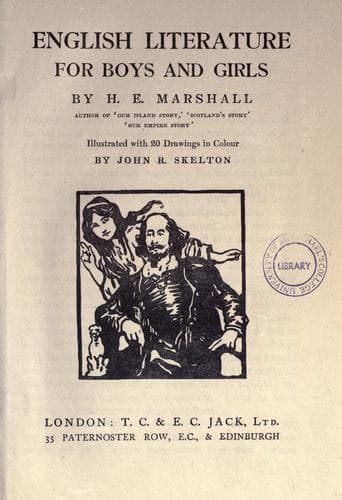
English Literature for Boys and GirlsMarshall, H. E. (Henrietta Elizabeth)
History
English Literature for Boys and Girls
Marshall, H. E. (Henrietta Elizabeth)
English literature -- History and criticism
The years passed for Jonson, if not in wealth, at least in such
comfort as his way of life allowed. For we cannot ever think of
him as happy in his own home by his own fireside. He is rather a
king in Clubland spending his all freely and taking no thought
for the morrow. But in 1625 King James died, and although the
new King Charles still continued the poet's pension, his tastes
were different from those of his father, and Jonson found himself
and his Masques neglected. His health began to fail too, and his
library, which he dearly loved, was burned, together with many of
his unpublished manuscripts, and so he fell on evil days.
Forgotten at court, Jonson began once more to write for the
stage. But now that he had to write for bread, it almost seemed
as if his pen had lost its charm. The plays he wrote added
nothing to his fame. They were badly received. And so at last,
in trouble for to-morrow's bread, without wife or child to
comfort him, he died on 8th August, 1637.
He was buried in Westminster, and it was intended to raise a fine
tomb over his grave. But times were growing troublous, and the
monument was still lacking, when a lover of the poet, Sir John
Young of Great Milton, in Oxfordshire, came to do honor to his
tomb. Finding it unmarked, he paid a workman 1s. 6d. to carve
above the poet's resting-place the words, "O rare Ben Jonson."
And perhaps these simple words have done more to keep alive the
memory of the poet than any splendid monument could have done.
Chapter XLIX JONSON--"THE SAD SHEPHERD"
ALTHOUGH Ben Jonson's days ended sadly, although his later plays
showed failing powers, he left behind him unfinished a Masque
called The Sad Shepherd which is perhaps more beautiful and more
full of music than anything he ever wrote. For Ben's charm did
not lie in the music of his words but in the strength of his
drawing of character. As another poet has said of him, "Ben as a
rule--a rule which is proved by the exception--was one of the
singers who could not sing; though, like Dryden, he could intone
most admirably."*
*Swinburne.
The Sad Shepherd is a tale of Robin Hood. Here once more we find
an old story being used again, for we have already heard of Robin
Hood in the ballads. Robin Hood makes a great fest to all the
shepherds and shepherdesses round about. All are glad to come,
save one Aeglamon, the Sad Shepherd, whose love, Earine, has, he
believes, been drowned. But later in the play we learn that
Earine is not dead, but that a wicked witch, Mother Maudlin, has
enchanted her, and shut her up in a tree. She had done this in
order to force Earine to give up Aeglamon, her true lover, and
marry her own wretched son Lorel.
When the play begins, Aeglamon passes over the stage mourning for
his lost love.
Public-domain text, read in full here on John Shaqi.
Reviews
Reviews
No reviews yet
Be the first to share your thoughts on this work.
Elsewhere in the archive
Join the Discussion
Join the discussion
Sign in to leave a comment or review.
Sign InorCreate an account