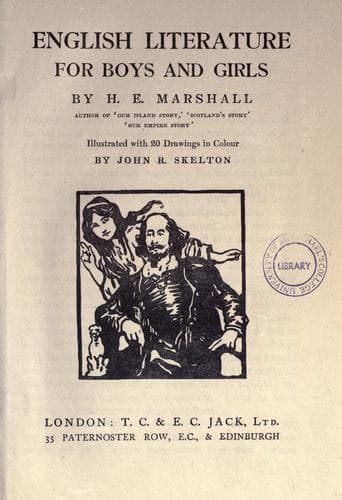
English Literature for Boys and GirlsMarshall, H. E. (Henrietta Elizabeth)
History
English Literature for Boys and Girls
Marshall, H. E. (Henrietta Elizabeth)
English literature -- History and criticism
In the beginning of the fight one little store ship of the
English fleet hovered near. It was small and of no use in
fighting. Now it came close to the Revenge and the Captain asked
Sir Richard what he should do, and "Sir Richard bid him save
himself, and leave him to his fortune." So the gallant Revenge
was left to fight alone. For fifteen hours the battle lasted,
Sir Richard himself was sorely wounded, and when far into the
night the fighting ceased, two of the Spanish vessels were sunk
"and in many other of the Spanish ships great slaughter was
made." "But the Spanish ships which attempted to board the
Revenge, as they were wounded and beaten off, so always others
came in their places, she having never less than two might
galleons by her sides and aboard her. So that ere the morning,
from three of the clock the day before, there had fifteen several
Armadas* assailed her. And all so ill approved their
entertainment, as they were, by the break of day, far more
willing to hearken to a composition** than hastily to make any
more assaults or entries.
*Armada here means merely a Spanish ship of war.
**An arrangement to cease fighting on both sides.
"But as the day increased so our men decreased. And as the light
grew more and more, by so much more grew our discomforts. For
none appeared in sight but enemies, saving one small ship called
the Pilgrim, commanded by Jacob Whiddon, who hovered all night to
see the success. But in the morning bearing with the Revenge,
she was hunted like a hare amongst many ravenous hounds, but
escaped.
"All the powder of the Revenge to the last barrel was now spent,
all her pikes broken, forty of her best men slain, and the most
part of the rest hurt. In the beginning of the fight she had but
one hundred free from sickness and four score and ten sick, laid
in hold upon the ballast. A small troop to man such a ship, and
a weak garrison to resist so mighty an army. By those hundred
all was sustained, the volleys, boarding and enterings of fifteen
ships of war, besides those which beat her at large.
"On the contrary, the Spanish were always supplied with soldiers
brought from every squadron; all manner of arms and power at
will. Unto ours there remained no comfort at all, no hope, no
supply either of ships, men, or weapons; the masts all beaten
overboard, all her tackle cut asunder, her upper work altogether
razed, and in effect evened she was with the water, but the very
foundation of a ship, nothing being left overhead for flight or
defence.
Public-domain text, read in full here on John Shaqi.
Reviews
Reviews
No reviews yet
Be the first to share your thoughts on this work.
Elsewhere in the archive
Join the Discussion
Join the discussion
Sign in to leave a comment or review.
Sign InorCreate an account