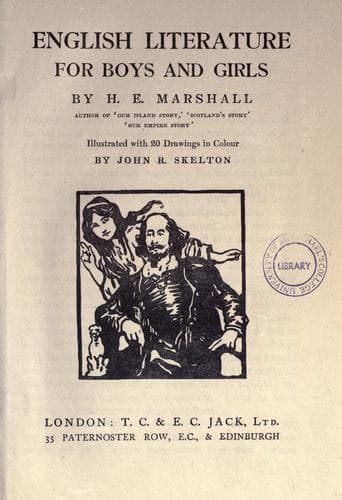
English Literature for Boys and GirlsMarshall, H. E. (Henrietta Elizabeth)
History
English Literature for Boys and Girls
Marshall, H. E. (Henrietta Elizabeth)
English literature -- History and criticism
"So he left us. And when we offered him some pistolets he
smiling said, 'He must not be twice paid for one labour,'
meaning, as I take it, that he had salary sufficient of the State
for his service. For (as I after leaned) they call an officer
that taketh rewards, twice paid."
So next morning the people landed from the ship, and Bacon goes
on to tell us of the wonderful things they saw and learned in the
island. The most wonderful thing was a place called Solomon's
House. In describing it Bacon was describing such a house as he
hoped one day to see in England. It was a great establishment in
which everything that might be of use to mankind was studied and
taught. And Bacon speaks of many things which were only guessed
at in his time. He speaks of high towers wherein people watched
"winds, rain, snow, hail and some of the fiery meteors also."
To-day we have observatories. He speaks of "help for the sight
far above spectacles and glasses," also "glasses and means to see
small and minute bodies perfectly and distinctly, as the shapes
and colours of small flies and worms, grains and flaws in gems,
which cannot otherwise be seen." To-day we have the microscope.
He says "we have also means to convey sounds in trunks and pipes,
in strange lines and distances," yet in those days no one had
dreamed of a telephone. "We imitate also flights of birds; we
have some degrees of flying in the air. We have ships and boats
for going under water," yet in those days stories of flying-ships
or torpedoes would have been treated as fairy tales.
Bacon did not finish The New Atlantis. "The rest was not
perfected" are the last words in the book and it was not
published until after his death. These words might almost have
been written of Bacon himself. A great writer, a great man,--but
"The rest was not perfected." He put his trust in princes and he
fell. Yet into the land of knowledge--
"Bacon, like Moses, led us forth at last;
The barren wilderness he passed,
Did on the very border stand
Of the blest promised land,
And from the mountain's top of his exalted wit
Saw it himself and shew'd us it.
But life did never to one man allow
Time to discover worlds and conquer too;
Nor can so short a line sufficient be,
To fathom the vast depths of nature's sea.
The work he did we ought t'admire,
And were unjust if we should more require
From his few years, divided twixt th' excess
Of low affliction and high happiness.
For who on things remote can fix his sight
That's always in a triumph or a fight."*
*Abraham Cowley, To the Royal Society.
Public-domain text, read in full here on John Shaqi.
Reviews
Reviews
No reviews yet
Be the first to share your thoughts on this work.
Elsewhere in the archive
Join the Discussion
Join the discussion
Sign in to leave a comment or review.
Sign InorCreate an account