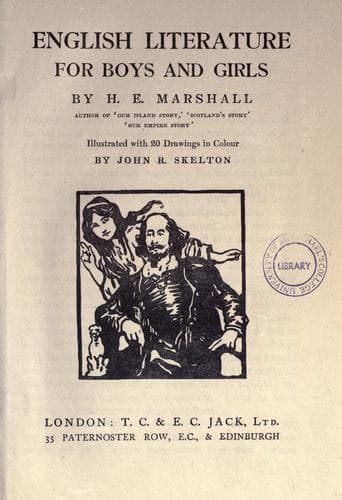
English Literature for Boys and GirlsMarshall, H. E. (Henrietta Elizabeth)
History
English Literature for Boys and Girls
Marshall, H. E. (Henrietta Elizabeth)
English literature -- History and criticism
But while dramatic poetry declined, lyric poetry flourished.
Lyric comes from the Greek word lura, a lyre, and all lyric
poetry was at one time meant to be sung. Now we use the word for
any short poem whether meant to be sung or not. In the times of
James and Charles there were many lyric poets. Especially in the
time of Charles it was natural that poets should write lyrics
rather than longer poems. For a time of strong action, of fierce
struggle was beginning, and amid the clash of arms men had no
leisure to sit in the study and ponder long and quietly. But
life brought with it many sharp and quick moments, and these
could be best expressed in lyric poetry. And as was natural when
religion was more and more being mixed with politics, when life
was forcing people to think about religion whether they would or
not, many of these lyric poets were religious poets. Indeed this
is the great time of English religious poetry. So these lyric
poets were divided into two classes, the religious poets and the
court poets, gay cavaliers these last who sang love-songs, love-
songs, too, in which we often seem to hear the clash of swords.
For if these brave and careless cavaliers loved gayly, they
fought and died as gayly as they loved.
Later on when you come to read more in English literature, you
will learn to know many of these poets. In this book we have not
room to tell about them or even to mention their names. Their
stories are bound up with the stories of the times, and many of
them fought and suffered for their king. But I will give you one
or two poems which may make you want to know more about the
writers of them.
Here are two written by Richard Lovelace, the very model of a gay
cavalier. While he was at Oxford, King Charles saw him and made
him M.A. or Master of Arts, not for his learning, but because of
his beautiful face. He went to court and made love and sang
songs gayly. He went to battle and fought and sang as gayly, he
went to prison and still sang. To the cause of his King he clung
through all, and when Charles was dead and Cromwell ruled with
his stern hand, and song was hushed in England, he died miserably
in a poor London alley.
The first of these songs was written by Lovelace while he was in
prison for having presented a petition to the House of Commons
asking that King Charles might be restored to the throne.
TO ALTHEA FROM PRISON
"When love with unconfinéd wings
Hovers within my gates,
And my divine Althea brings
To whisper at the grates;
When I lye tangled in her haire,
And fettered to her eye,
The gods, that wanton in the aire,
Know no such liberty.
. . . . .
"When (like committed linnets) I
With shriller throat shall sing
The sweetness, mercy, majesty,
And glories of my King.
When I shall voyce aloud, how good
He is, how great should be,
Enlargéd winds, that curle the flood,
Know no such liberty.
Public-domain text, read in full here on John Shaqi.
Reviews
Reviews
No reviews yet
Be the first to share your thoughts on this work.
Elsewhere in the archive
Join the Discussion
Join the discussion
Sign in to leave a comment or review.
Sign InorCreate an account