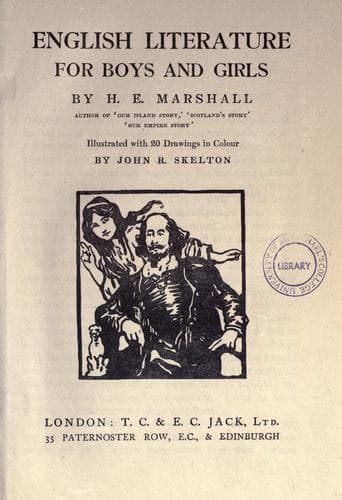
English Literature for Boys and GirlsMarshall, H. E. (Henrietta Elizabeth)
History
English Literature for Boys and Girls
Marshall, H. E. (Henrietta Elizabeth)
English literature -- History and criticism
In these few cavalier songs we can see the spirit of the times.
There is gay carelessness of death, strong courage in misfortune,
passionate loyalty. There is, too, the proud spirit of the
tyrant, which is gentle and loving when obeyed, harsh and cruel
if disobeyed.
There is another song by a cavalier poet which I should like to
give you. It is a love-song, too, but it does not tell of these
stormy times, or ring with the noise of battle. Rather it takes
us away to a peaceful summer morning before the sun is up, when
everything is still, when the dew trembles on every blade of
grass, and the air is fresh and cool, and sweet with summer
scents. And in this cool freshness we hear the song of the lark:
"The lark now leaves his wat'ry nest,
And, climbing, shakes his dewy wings;
He takes this window for the east;
And to implore your light, he sings;
'Awake, awake! the Morn will never rise,
Till she can dress her beauty at your eyes.'
"The merchant bow unto the seaman's star,
The ploughman from the Sun his season takes;
But still the lover wonders what they are,
Who look for day before his mistress wakes.
'Awake, awake! break thro' your veils of lawn!
Then draw your curtains, and begin the dawn.'"
That was written by William Davenant, poet-laureate. It is one
our most beautiful songs, and he is remembered by it far more
than by his long epic poem called Gondibert which few people now
read. But I think you will agree with me that his name is worthy
of being remembered for that one song alone.
Chapter LV HERBERT--THE PARSON POET
HAVING told you a little about the songs of the cavaliers I must
now tell you something about the religious poets who were a
feature of the age. Of all our religious poets, of this time at
least, George Herbert is the greatest. He was born in 1593 near
the town of Montgomery, and was the son of a noble family, but
his father died when he was little more than three, leaving his
mother to bring up George with his nine brothers and sisters.
George Herbert's mother was a good and beautiful woman, and she
loved her children so well that the poet said afterwards she had
been twice a mother to him.
At twelve he was sent to Westminster school where we are told
"the beauties of his pretty behaviour shined" so that he seemed
"to become the care of Heaven and of a particular good angel to
guard and guide him."*
*Izaak Walton.
At fifteen he went to Trinity College, Cambridge. And now,
although separated from his "dear and careful Mother"* he did not
forget her or all that she had taught him. Already he was a
poet. We find him sending verses as a New Year gift to his
mother and writing to her that "my poor abilities in poetry shall
be all and ever consecrated to God's glory."
*The same.
Public-domain text, read in full here on John Shaqi.
Reviews
Reviews
No reviews yet
Be the first to share your thoughts on this work.
Elsewhere in the archive
Join the Discussion
Join the discussion
Sign in to leave a comment or review.
Sign InorCreate an account