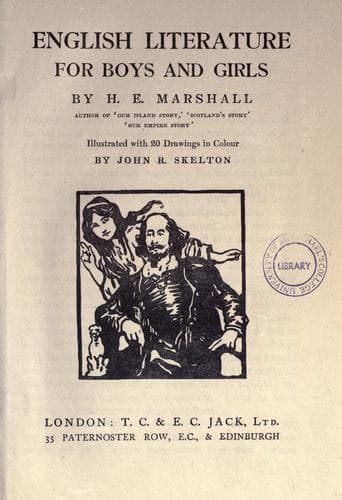
English Literature for Boys and GirlsMarshall, H. E. (Henrietta Elizabeth)
History
English Literature for Boys and Girls
Marshall, H. E. (Henrietta Elizabeth)
English literature -- History and criticism
There is all the strong courage in these lines of the courtier-
parson. They make us remember that before he put on his priest's
robe he wore a sword. They are full of the fearless goodness
that was the mark of his gentle soul. And now, to end the
chapter, I will give you another little poem full of beauty and
tenderness. It is called The Pulley. Herbert often gave quaint
names to his poems, names which at first sight seem to have
little meaning. Perhaps you may be able to find out why this is
called The Pulley.
"When God at first made man,
Having a glass of blessings standing by,
'Let us,' said He, 'pour on him all we can;
Let the world's riches which disperséd lie,
Contract into a span.'
"So strength first made way,
Then beauty flowed, then wisdom, honour, pleasure;
When almost all was out, God made a stay,
Perceiving that, alone of all His treasure,
Rest in the bottom lay.
"'For if I should,' said He,
'Bestow this jewel on My creature,
He would adore My gifts instead of Me,
And rest in Nature, not the God of Nature:
So both should losers be.
"'Yet let him keep the rest,
But keep them with repining restlessness;
Let him be rich and weary, that at least,
If goodness lead him not, yet weariness
May toss him to my breast.'"
Chapter LVI HERRICK AND MARVELL--OF BLOSSOMS AND BOWERS
ANOTHER poet of this age, Robert Herrick, in himself joined the
two styles of poetry of which we have been speaking, for he was
both a love poet and a religious poet.
He was born in 1591 and was the son of an old, well-to-do family,
his father being a London goldsmith. But, like Herbert, he lost
his father when he was but a tiny child. Like Herbert again he
went to Westminster School and later Cambridge. But before he
went to Cambridge he was apprenticed to his uncle, who was a
goldsmith, as his brother, Herrick's father, had been. Robert,
however, never finished his apprenticeship. He found out, we may
suppose, that he had no liking for the jeweler's craft, that his
hand was meant to create jewels of another kind. So he left his
uncle's workshop and went to Cambridge, although he was already
much beyond the usual age at which boys then went to college.
Like Herbert he went to college meaning to study for the Church.
But according to our present-day ideas he seems little fitted to
have been a priest. For although we know little more than a few
bare facts about Herrick's life, when we have read his poems and
looked at his portrait we can draw for ourselves a clear picture
of the man, and the picture will not fit in with our ideas of
priesthood.
Public-domain text, read in full here on John Shaqi.
Reviews
Reviews
No reviews yet
Be the first to share your thoughts on this work.
Elsewhere in the archive
Join the Discussion
Join the discussion
Sign in to leave a comment or review.
Sign InorCreate an account