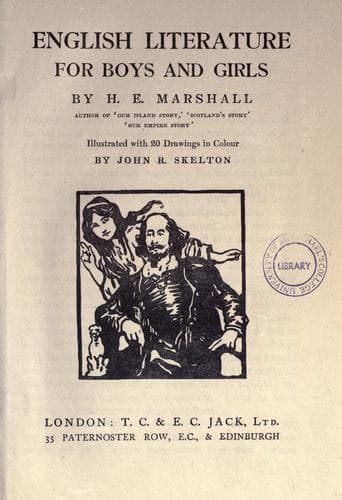
English Literature for Boys and GirlsMarshall, H. E. (Henrietta Elizabeth)
History
English Literature for Boys and Girls
Marshall, H. E. (Henrietta Elizabeth)
English literature -- History and criticism
"Though Clock,
To tell how night draws hence, I've none,
A Cock
I have, to sing how day draws on.
I have
A maid (my Prue) by good luck sent,
To save
That little, Fates me gave or lent.
A Hen
I keep, which, creeking* day by day,
Tells when
She goes her long white egg to lay.
A Goose
I have, which, with a jealous ear,
Lets loose
Her tongue, to tell what danger's near.
A Lamb
I keep, tame, with my morsels fed,
Whose Dam
An orphan left him, lately dead.
A Cat
I keep, that plays about my house,
Grown fat
With eating many a miching** mouse.
To these
A Tracy*** I do keep, whereby
I please
The more my rural privacy,
Which are
But toys to give my heart some ease;
Where care
None is, slight things do lightly please."
*Clucking.
**Thieving.
***His spaniel.
But Herrick did not love his country home and parish or his
people. We are told that the gentry round about loved him "for
his florid and witty discourses." But his people do not seem to
have loved these same discourses, for we are also told that one
day in anger he threw his sermon from the pulpit at them because
they did not listen attentively. He says:--
"More discontents I never had,
Since I was born, than here,
Where I have been, and still am sad,
In this dull Devonshire."
Yet though Herrick hated Devonshire, or at least said so, it was
this same wild country that called forth some of his finest
poems. He himself knew that, for in the next lines he goes on to
say:--
"Yet justly, too, I must confess
I ne'er invented such
Ennobled numbers for the press,
Than where I loathed so much."
Yet it is not the ruggedness of the Devon land we feel in
Herrick's poems. We feel rather the beauty of flowers, the
warmth of sun, the softness of spring winds, and see the greening
trees, the morning dews, the soft rains. It is as if he had not
let his eyes wander over the wild Devonshire moorlands, but had
confined them to his own lovely garden and orchard meadow, for he
speaks of the "dew-bespangled herb and tree," the "damasked
meadows," the "silver shedding brooks." Hardly any English poet
has written so tenderly of flowers as Herrick. One of the best
known of these flower poems is To Daffodils.
"Fair Daffodils, we weep to see
You haste away so soon;
As yet the early-rising sun
Has not attain'd his noon.
Stay, stay,
Until the hasting day
Has run
But to the Even-song;
And, having pray'd together, we
Will go with you along.
Public-domain text, read in full here on John Shaqi.
Reviews
Reviews
No reviews yet
Be the first to share your thoughts on this work.
Elsewhere in the archive
Join the Discussion
Join the discussion
Sign in to leave a comment or review.
Sign InorCreate an account