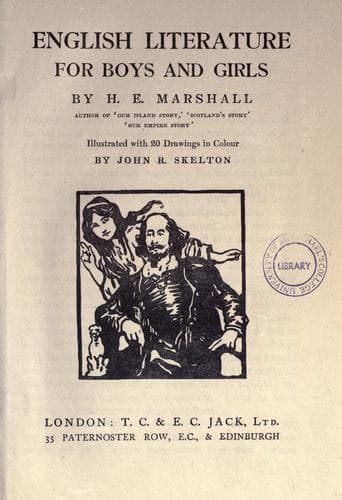
English Literature for Boys and GirlsMarshall, H. E. (Henrietta Elizabeth)
History
English Literature for Boys and Girls
Marshall, H. E. (Henrietta Elizabeth)
English literature -- History and criticism
While Herrick lived his quiet, dull life and wrote poetry in the
depths of Devonshire, the country was being torn asunder and
tossed from horror to horror by the great Civil War. Men took
sides and fought for Parliament or for King. Year by year the
quarrel grew. What was begun at Edgehill ended at Naseby where
the King's cause was utterly lost. Then, although Herrick took
no part in the fighting, he suffered with the vanquished, for he
was a Royalist at heart. He was turned out of his living to make
room for a Parliament man. He left this parish without regret.
"Deanbourne, farewell; I never look to see
Deane, or thy warty incivility.
Thy rocky bottom, that doth tear thy streams,
And makes them frantic, ev'n to all extremes;
To my content, I never should behold,
Were thy streams silver, or thy rocks all gold.
Rocky thou art, and rocky we discover
Thy men: and rocky are thy ways all over.
O men, O manners, now and ever known
To be a rocky generation:
A people currish; churlish as the seas;
And rude, almost, as rudest savages:
With whom I did, and may re-sojourn when
Rocks turn to rivers, rivers turn to men."
Hastening to London, he threw off his sober priest's robe, and
once more putting on the gay dress worn by the gentlemen of his
day he forgot the troubles and the duties of a country parson.
Rejoicing in his freedom he cried:--
"London my home is: though by hard fate sent
Into a long and irksome banishment;
Yet since called back; henceforward let me be,
O native country, repossess'd by thee."
He had no money, but he had many wealthy friends, so he lived, we
may believe, merrily enough for the next fifteen years. It was
during these years that the Hesperides was first published,
although for a long time before many people had known his poems,
for they had been handed about among his friends in manuscript.
So the years passed for Herrick we hardly know how. In the great
world Cromwell died and Charles II returned to England to claim
the throne of his fathers. Then it would seem that Herrick had
not found all the joy he had hoped for in London, for two years
later, although rocks had not turned to rivers, nor rivers to
men, he went back to his "loathed Devonshire."
After that, all that we know of him is that at Dean Prior "Robert
Herrick vicker was buried ye 15th day of October 1674." Thus in
twilight ends the life of the greatest lyric poet of the
seventeenth century.
All the lyric poets of whom I have told you were Royalists, but
the Puritans too had their poets, and before ending this chapter
I would like to tell you a little of Andrew Marvell, a
Parliamentary poet.
If Herrick was a lover of flowers, Marvell was a lover of
gardens, woods and meadows. The garden poet he has been called.
He felt himself in touch with Nature:--
"Thus I, easy philosopher,
Among the birds and trees confer,
Public-domain text, read in full here on John Shaqi.
Reviews
Reviews
No reviews yet
Be the first to share your thoughts on this work.
Elsewhere in the archive
Join the Discussion
Join the discussion
Sign in to leave a comment or review.
Sign InorCreate an account