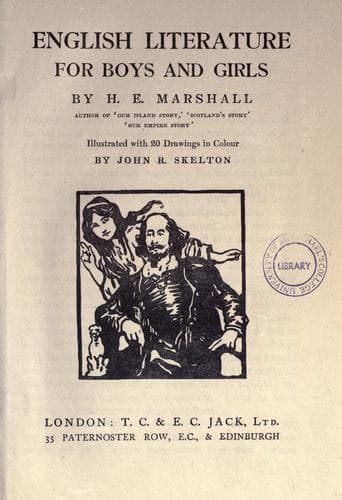
English Literature for Boys and GirlsMarshall, H. E. (Henrietta Elizabeth)
History
English Literature for Boys and Girls
Marshall, H. E. (Henrietta Elizabeth)
English literature -- History and criticism
All these poems of which I have told you, Milton wrote during the
quiet years spent at Horton. But at length these days came to an
end. He began to feel his life in the country cramped and
narrow. He longed to go out into the great wide world and see
something of all the beauties and wonder of it. Italy, which had
called so many of our poets, called him. Once more his kindly
father let him do as he would. He gave him money, provided him
with a servant, and sent him forth on his travels. For more than
a year Milton wandered, chiefly among the sunny cities of Italy.
He meant to stray still further to Sicily and Greece, but news
from home called him back, "The sad news of Civil War." "I
thought it base," he said, "that while my fellow-countrymen were
fighting at home for liberty, I should be traveling abroad at
ease."
When Milton returned home he did not go back to Horton, but set
up house in London. Here he began to teach his two nephews, his
sister's children, who were boys of nine and ten. Their father
had died, their mother married again, and Milton not only taught
the boys, but took them to live with him. He found pleasure, it
would seem, in teaching, for soon his little class grew, and he
began to teach other boys, the sons of friends.
Milton was a good master, but a severe one. The boys were kept
long hours at their lessons, and we are told that in a year's
time they could read a Latin author at sight, and within three
years they went through the best Latin and Greek poets. But "as
he was severe on one hand, so he was most familiar and free in
his conversation to those to whom most sour in his way of
education." He himself showed the example of "hard study and
spare diet,"** for besides teaching the boys he worked and wrote
steadily, study being ever the "grand affair of his life."**
Only now and again he went to see "young sparks" of his
acquaintance, "and now and then to keep a gawdy-day."** It is
scarce to be imagined that a gawdy-day in which John Milton took
part could have been very riotous.
*Aubrey.
**Philips.
Public-domain text, read in full here on John Shaqi.
Reviews
Reviews
No reviews yet
Be the first to share your thoughts on this work.
Elsewhere in the archive
Join the Discussion
Join the discussion
Sign in to leave a comment or review.
Sign InorCreate an account