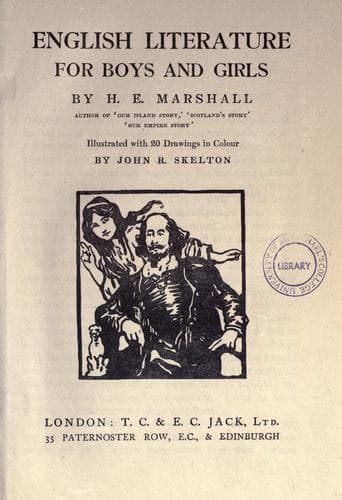
English Literature for Boys and GirlsMarshall, H. E. (Henrietta Elizabeth)
History
English Literature for Boys and Girls
Marshall, H. E. (Henrietta Elizabeth)
English literature -- History and criticism
So wrote Dryden. But after the death of Cromwell came the
Restoration. Dryden had been able to admire Cromwell, but
although he came of a Puritan family he could never have been a
Puritan at heart. What we learn of him in his writings show us
that. He was not of the stern stuff which makes martyrs and
heroes. There was no reason why he should suffer for a cause in
which he did not whole-heartedly believe. So Dryden turned
Royalist, and the very next poem he wrote was On the Happy
Restoration and Return of His Majesty Charles the Second.
"How easy 'tis when destiny proves kind,
With full spread sails to run before the wind!"*
*Astroe Redux.
So Dryden ran before the wind.
About three years after the Restoration Dryden married an earl's
daughter, Lady Elizabeth Howard. We know very little about their
life together, but they had three children of whom they were very
fond.
With the Restoration came the re-opening of the theaters, and for
fourteen years Dryden was known as a dramatic poet. There is
little need to tell you anything about his plays, for you would
not like to read them. During the reign of Puritanism in England
the people had been forbidden even innocent pleasures. The
Maypole dances had been banished, games and laughter were frowned
upon. Now that these too stern laws had been taken away, people
plunged madly into pleasure: laughter became coarse, merriment
became riotous. Puritan England had lost the sense of where
innocent pleasure ends and wickedness begins. In another way
Restoration England did the same. The people of the Restoration
saw fun and laughter in plays which seem to us now simply vulgar
and coarse as well as dull. The coarseness, too, is not the
coarseness of an ignorant people who know no better, but rather
of a people who do know better and who yet prefer to be coarse.
I do not mean to say that there are no well-drawn characters, no
beautiful lines, in Dryden's plays for that would not be true.
Many of them are clever, the songs in them are often beautiful,
but nearly all are unpleasant to read. The taste of the
Restoration times condemned Dryden to write in a way unworthy of
himself for money. "Neither money nor honour--that in two words
was the position of writers after the Restoration."*
*Beljame, Le Public et les Hommes de Lettres in Angleterre.
"And Dryden, in immortal strain,
Had raised the table-round again
But that a ribald King and Court
Bade him toil on to make them sport,
Demanding for their niggard pay,
Fit for their souls, a loser lay."*
*Walter Scott, Marmion.
Public-domain text, read in full here on John Shaqi.
Reviews
Reviews
No reviews yet
Be the first to share your thoughts on this work.
Elsewhere in the archive
Join the Discussion
Join the discussion
Sign in to leave a comment or review.
Sign InorCreate an account