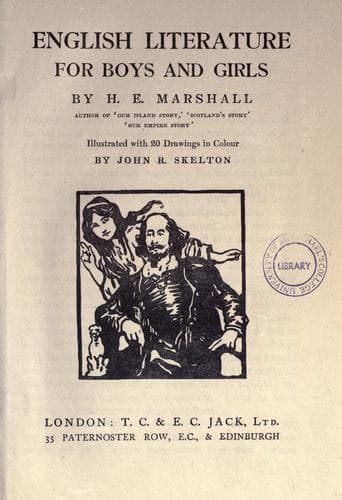
English Literature for Boys and GirlsMarshall, H. E. (Henrietta Elizabeth)
History
English Literature for Boys and Girls
Marshall, H. E. (Henrietta Elizabeth)
English literature -- History and criticism
But the reign of James II was short. The "Glorious Revolution"
came, and with a Protestant King and Queen upon the throne, the
Catholic Poet Laureate lost his post and pension and all his
other appointments. Dryden was now nearly sixty; and although he
had made what was then a good deal of money by his plays and
other poems he had spent it freely, and always seemed in need.
Now he had to face want and poverty. But he faced them bravely.
Dryden all his life had been a flatterer; he had always sailed
with the wind. Now, whether he could not or would not, he
changed no more, he flattered no more. A kind friend, it is
said, still continued to pay him the two hundred pounds he had
received as Poet Laureate, and he now wrote more plays which
brought him money. Then, thus late in life, he began the work
which for you at present will have the greatest interest. Dryden
was a great poet, but he could create nothing, he had to have
given him ideas upon which to work. Now he began translations
from Latin poets, and for those who cannot read them in the
original they are still a great pleasure and delight.
True, Dryden did not translate literally, that is word for word.
He paraphrased rather, and in doing so he Drydenized the
originals, often adding whole lines of his own. Among his
translations was Virgil's Aeneid, which long before, you remember,
Surrey had begun in blank verse. But blank verse was not what
the age in which Dryden lived desired, and he knew it. So he
wrote in rimed couplets. Long before this he had turned Milton's
Paradise Lost into rimed couplets, making it into an opera, which
he called The State of Innocence. An opera is a play set to
music, but this opera was never set to music, and never sung or
acted. Dryden, we know, admired Milton's poetry greatly. "This
man cuts us all out," he had said. Yet he thought he could make
the poem still better, and asked Milton's leave to turn it into
rime. "Ay, you may tag my verses if you will," replied the great
blind man.
It is interesting to compare the two poems, and when you come to
read The State of Innocence you will find that not all the verses
are "tagged." So that in places you can compare Milton's blank
verse with Dryden's. And although Dryden must have thought he
was improving Milton's poem, he says himself: "Truly I should be
sorry, for my own sake, that any one should take the pains to
compare them (the poems) together, the original being,
undoubtedly, one of the greatest, most noble, and most sublime
poems which either this age or nation has produced."
Dryden begins his poem with the speech of Satan, Lucifer he calls
him, on finding himself cast out from heaven:--
"Is this the seat our conqueror has given?
And this the climate we must change for heaven?
These regions and this realm my wars have got;
This mournful empire is the loser's lot;
In liquid burnings, or on dry, to dwell,
Is all the sad variety of hell."
Public-domain text, read in full here on John Shaqi.
Reviews
Reviews
No reviews yet
Be the first to share your thoughts on this work.
Elsewhere in the archive
Join the Discussion
Join the discussion
Sign in to leave a comment or review.
Sign InorCreate an account