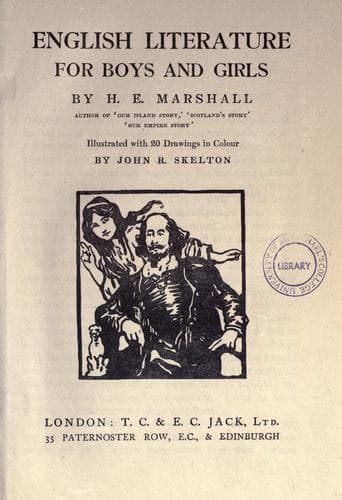
English Literature for Boys and GirlsMarshall, H. E. (Henrietta Elizabeth)
History
English Literature for Boys and Girls
Marshall, H. E. (Henrietta Elizabeth)
English literature -- History and criticism
Then, in an outburst of joy, he thanks and blesses everything
that has led up to this happy day, which has brought him under
"Love's yoke which easy is and sure." Even his exile and his
prison he thanks.
"And thankéd be the fair castle wall
Whereas I whilcome looked forth and leant."
The King's Quair reminds us very much of Chaucer's work. All
through it there are lines which might have been written by
Chaucer, and in the last verse James speaks of Gower and Chaucer
as his "masters dear." Of Gower I have said nothing in this
book, because there is not room to tell of every one, and he is
not so important as some or so interesting as others. So I leave
you to learn about him later. It is to Chaucer, too, much more
than to Gower that James owes his music. And if he is grave like
Gower rather than merry like Chaucer, we must remember that for
nineteen years he had lived a captive, so that it was natural his
verse should be somber as his life had been. And though there is
no laughter in this poem, it shows a power of feeling joy as well
as sorrow, which makes us sad when we remember how long the poet
was shut away from common human life.
The King's Quair is written in verses of seven lines. Chaucer
used this kind of verse, but because King James used it too, and
used it so well, it came to be called the Rhyme Royal.
King James's story had a happy ending. A story with a happy
ending must end of course with a wedding, and so did this one.
The King of England, now Henry VI, was only a child. But those
who ruled for him were quite pleased when they heard that Prince
James had fallen in love with the beautiful lady of the garden,
for she was the King's cousin, Lady Jane Beaufort. They set
James free and willingly consented that he should marry his lady,
for in this way they hoped to bind England and Scotland together,
and put an end to wars between the two countries. So there was a
very grand wedding in London when the lovely lady of the garden
became Queen of Scotland. And then these two, a King and Queen,
yet happy as any simple lovers journeyed northward to their
kingdom.
They were received with great rejoicing and crowned at Scone.
But the new King soon found, that during the long years he had
been kept a prisoner in England his kingdom had fallen into wild
disorder. Sternly he set himself to bring order out of disorder,
and the wilfull, lawless nobles soon found to their surprise that
the gentle poet had a will of iron and a hand of steel, and that
he could wield a sword and scepter as skillfully as his pen.
James I righted much that was wrong. In doing it he made for
himself many enemies. But of all that he did or tried to do in
the twelve years that he ruled you will read in history books.
Here I will only tell you of his sad death.
Public-domain text, read in full here on John Shaqi.
Reviews
Reviews
No reviews yet
Be the first to share your thoughts on this work.
Elsewhere in the archive
Join the Discussion
Join the discussion
Sign in to leave a comment or review.
Sign InorCreate an account