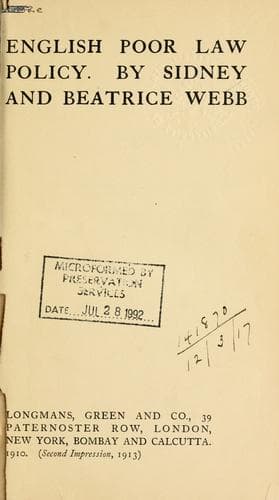
Great Britain. Royal Commission on Poor Laws and Relief of Distress; Poor -- Great Britain; Poor laws -- Great Britain
[333] Circular of 9th January 1856, in Ninth Annual Report, 1857,
pp. 13, 15. In 1856 it was reported that there were in Lancashire
and the West Riding 48,412 children on outdoor relief, of whom
about 30,000 ought to be at school. Yet down to December 1855, the
boards of guardians had taken no steps to get them to school, in
spite of the inspector's protests (Eighth Annual Report, 1855, p.
63).
[334] House of Commons Return, No. 437 of 1856; Ninth Annual
Report, p. 8. Newcastle-on-Tyne adopted it at once (MS. Minutes,
Newcastle Board of Guardians, 10th October 1855).
[335] Fifteenth Annual Report, 1862-3, p. 18; Circular of 29th
September 1862.
[336] MS. Minutes, Manchester Board of Guardians, 9th October
1862. The Manchester Guardians, whose early school experiment we
have already mentioned, largely nullified their own action (and
apparently contravened the spirit, if not the letter of the law),
by insisting on the attendance of the outdoor paupers exclusively
at the guardians' own school, which gave "undenominational"
religious instruction, and refusing to pay fees for children to go
to any other schools (except for a short time in 1862-3 when their
own schools were over-full). In vain did the Roman Catholics and
the Manchester and Salford Education Aid Society protest, pointing
out that the children were in consequence growing up untaught
(_ibid._ 26th May, 23rd and 30th June, and 10th November 1864;
19th June 1865). The Central Authority does not appear to have
intervened.
Public-domain text, read in full here on John Shaqi.
Reviews
Reviews
No reviews yet
Be the first to share your thoughts on this work.
Elsewhere in the archive
Join the Discussion
Join the discussion
Sign in to leave a comment or review.
Sign InorCreate an account