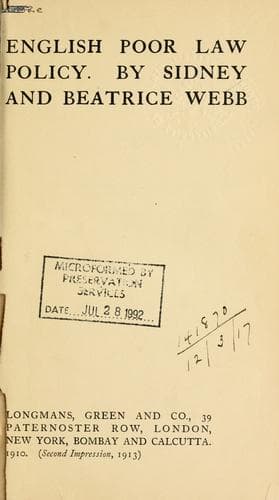
Great Britain. Royal Commission on Poor Laws and Relief of Distress; Poor -- Great Britain; Poor laws -- Great Britain
Then followed various detailed suggestions, some of which dealt with
ingredients and methods of cooking. Soup or broth dinners were not to be
given more than twice a week; nor were bread and cheese or suet pudding
dinners, except to the able-bodied. Fresh vegetables were to be
provided, if possible, five times a week, and boiled rice alone was not
to be made a substitute for them. Rice pudding was not to be given as a
dinner except to children under nine, and to them not more than twice a
week. Children were not to have tea or coffee, except for supper on
Sunday, but milk at breakfast and supper, and they were to be given two
or three ounces of bread at 10 A.M. It was "suggested that tea, coffee,
or cocoa, with milk and sugar, and accompanied by bread and butter or
bread and cheese, should be allowed to all the aged and infirm women at
breakfast and supper, and the same to aged and infirm men, or milk
porridge with bread" might be given at one of those meals. The ordinary
rations were--of meat (cooked, without bone), for men four ounces, for
women three ounces; of soup, one to one and a half pints (containing
three ounces of meat) for an adult; and of bread at breakfast or supper,
six ounces for able-bodied men, for the aged, women, and children over
nine five ounces, and proportionately less for younger children.[458]
[458] Circular of 7th December 1868, in Twenty-first Annual
Report, 1868-9, pp. 41-4. In the different Metropolitan workhouses
the Central Authority sought to obtain absolute uniformity, and to
this end had a model drawn up which was submitted to the guardians
for their adoption. It is strange that this dietary allowed less
bread and more meat than was recommended by the Board in the
circular just described, only a few months later--perhaps because
larger allowances of meat were made in the dietaries already in
force in London unions. This dietary, prepared by Dr. Markham,
contained tables for the able-bodied, the aged, and inmates
engaged on extra labour, in each case of both sexes, but not for
the other classes named in the above-mentioned circular. The
points chiefly dwelt upon were the necessity of good cooking, of
giving reasonable quantities of food, sufficient but not wasteful,
and of obtaining materials of good quality, so as to attain the
greatest possible economy (Circular of 23rd April 1868, in _ibid._
pp. 35-41). It is to be noted that the Central Authority issued no
order on the subject. The result was that in most cases the
guardians practically ignored the suggestions, and continued in
their diversity. Camberwell, for instance, continued to allow the
able-bodied pauper 107 oz. of bread per week, whereas the Poor Law
Board had suggested 76 oz. only. The hated oatmeal porridge and
suet pudding were minimised (Report of Mr. J. H. Bridges, 15th May
1873).
Public-domain text, read in full here on John Shaqi.
Reviews
Reviews
No reviews yet
Be the first to share your thoughts on this work.
Elsewhere in the archive
Join the Discussion
Join the discussion
Sign in to leave a comment or review.
Sign InorCreate an account