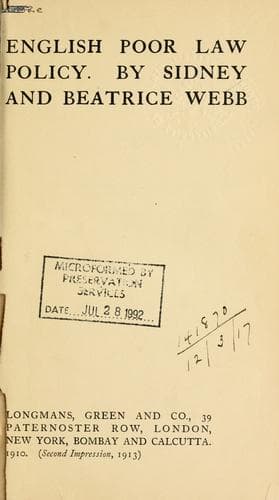
Great Britain. Royal Commission on Poor Laws and Relief of Distress; Poor -- Great Britain; Poor laws -- Great Britain
the public orders in such a way as to regularise the aggregate volume
of employment. As regards the Metropolis, it was recommended that
individual boards of guardians might contribute, with the sanction of
the Local Government Board, out of the Metropolitan Common Poor Fund,
half the cost of the works undertaken by the vestries or district
boards at their instance.[539] Moreover, as it had been discovered that
the Acts of 1819 and 1830 had not been repealed, which authorised the
local Poor Law authorities to purchase or hire not exceeding 50 acres
of land on which to set the poor to work at reasonable wages--statutes
which the Central Authority had persistently ignored as obsolete, and
had refused to make the rules under which alone they could be made
operative--the Committee recommended: "That the Local Government Board
should consider the application of such powers, and make rules for the
use of boards of guardians in relation thereto."[540]
[532] Circular of 14th November 1892, in Twenty-second Annual
Report, 1892-3, p. 38.
[533] Circulars of 27th March and 30th September 1893,
Twenty-third Annual Report, 1893-4, pp. lxiv-lxv; Board of Trade
Report on Agencies and Methods for dealing with the Unemployed,
1893 (C. 7182), pp. 187-206.
[534] Twenty-fourth Annual Report, 1894-5, pp. lxxi-lxxiii. The
local authorities were taking action before the Circular was sent;
_see_, for instance, MS. Minutes, Bradford Board of Guardians, 4th
February 1895, showing that they had decided on a deputation to
the town council on 23rd January; and that the town council, on
25th January, had agreed to find work in clearing away snow.
[535] _Ibid._ p. lxxiii; First, Second, and Third Reports of the
Select Committee on Distress from Want of Employment, 1895.
[536] Twenty-fourth Annual Report, 1894-5, p. lxxiv.
[537] Third Report of Select Committee on Distress from Want of
Employment, 1895, p. 560.
[538] The Lord Mayor of Manchester, in reply to deputation from
the Chorlton Board of Guardians, 1895; _see_ Second Report of
Committee on Distress from Want of Employment, 1895, p. 54.
[539] Third Report of Committee on Distress from Want of
Employment, 1895, p. v. The Committee also recommended the
abolition of the penalty of disfranchisement, on persons in
receipt of poor relief, so far as "the deserving man forced to
become dependent on public aid" was concerned (_Ibid._).
Public-domain text, read in full here on John Shaqi.
Reviews
Reviews
No reviews yet
Be the first to share your thoughts on this work.
Elsewhere in the archive
Join the Discussion
Join the discussion
Sign in to leave a comment or review.
Sign InorCreate an account