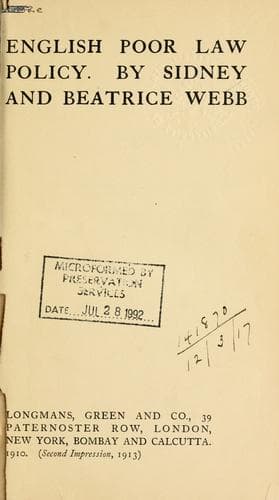
Great Britain. Royal Commission on Poor Laws and Relief of Distress; Poor -- Great Britain; Poor laws -- Great Britain
The class of children to which the law applies was, at the instance of
the Central Authority, considerably enlarged in 1899, and it is worth
considering how extensive it now is. "Where a child is maintained by the
guardians of a Poor Law union, and: (i.) the child has been deserted by
its parent; or (ii.) the guardians are of opinion that by reason of
mental deficiency, or of vicious habits, or mode of life, a parent of
the child is unfit to have the control of it; or (iii.) a parent is
unable to perform his or her parental duties by reason of being under
sentence of penal servitude or of being detained under the Inebriates
Act 1898; or (iv.) a parent of the child has been sentenced to
imprisonment in respect of any offence against any of his or her
children; or (v.) a parent of the child is permanently bedridden or
disabled, and is the inmate of a workhouse, and consents to the
resolution hereinafter mentioned; or (vi.) both the parents (or in the
case of an illegitimate child, the mother of the child) are (or is)
dead; the guardians may, at any time, resolve that until the child
reaches the age of eighteen years, all the rights and powers of such
parent as aforesaid, or, if both parents are dead, of the parents, in
respect of the child shall, subject as in this Act mentioned, vest in
the guardians." Penalties were also enacted against any person who shall
knowingly assist or induce any child adopted by the guardians to leave
their control. If any child maintained by the guardians is, with their
consent, adopted by some other person, their responsibility for the
child does not at once cease, for they are required, during three years
after the date of the adoption, to cause the child to be visited at
least twice a year, by some person appointed by them for the purpose;
and they have the power, if they see fit, to revoke their consent to the
adoption, and reassume custody of the child.[658]
[658] Poor Law Act, 1899, 62 & 63 Vic. c. 37, secs. 1-3.
Some boards of guardians--often on the suggestion of the
inspectorate--promptly made use of their new powers. On 1st June 1902,
the number of children already adopted up to that date was no fewer than
7724, of whom 1503 were then over fifteen.[659] It is to be noted that,
though the powers are applicable to all pauper children, the Central
Authority has not suggested their use except in respect of the children
in Poor Law institutions (including, however, the "ins and outs"),[660]
together with those technically "boarded out," or in certified schools;
and we do not find that they have ever been made use of for any of the
children maintained by the guardians on outdoor relief, however
disastrous is their upbringing.
[659] Thirty-second Annual Report, 1902-3, pp. lxii-lxiii.
[660] _Decisions of the Local Government Board_, 1903-4, by W. A.
Casson, 1905 p. 45.
_E._--THE SICK
Public-domain text, read in full here on John Shaqi.
Reviews
Reviews
No reviews yet
Be the first to share your thoughts on this work.
Elsewhere in the archive
Join the Discussion
Join the discussion
Sign in to leave a comment or review.
Sign InorCreate an account