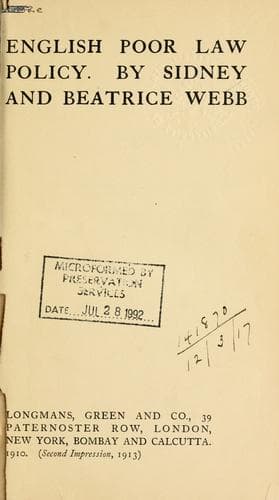
Great Britain. Royal Commission on Poor Laws and Relief of Distress; Poor -- Great Britain; Poor laws -- Great Britain
The Principle of "Less Eligibility"--that is, that the condition of the
pauper should be "less eligible" than that of the lowest grade of
independent labourer--(though, as we have shown, asserted explicitly in
the 1834 Report only of the able-bodied) is often regarded as the root
principle of the reforms of 1834. The Central Authority in 1907 applies
this principle unreservedly to one class only, the wayfarers or
vagrants. In respect of this class the application of the principle goes
even further than was contemplated in 1834. As will be remembered, the
Report of 1834 recommended that the wayfarer should be regarded merely
as an able-bodied person, and offered maintenance in the workhouse,
without compulsory detention or worse conditions than were afforded to
other inmates. In 1907 the Central Authority orders the wayfarer,
without discrimination of character or conduct, to be relieved only in a
casual ward, under a regimen not only inferior to that of the
able-bodied ward of the workhouse, but also, in food and amenity of
accommodation, distinctly less eligible than the condition of the
poorest independent labourer. Moreover, even this "less eligible" relief
is accompanied by compulsory detention and a task of hard labour of
monotonous and disagreeable character.
Exactly to what extent the policy of the Central Authority of to-day has
avowedly departed from the Principle of Less Eligibility with regard to
other sections of the able-bodied class it is difficult, in the absence
of explicit statement, to determine. According to the Statutes, Orders,
and Circulars now promulgated by the Central Authority, the able-bodied
(not being wayfarers) may be relieved in three main ways, among which
the local authority over a large part of England and Wales is left free
choice, viz.:--(_a_) maintenance in the workhouse, (_b_) outdoor relief
with a labour test, and (_c_) employment for wages[839] by the distress
committee. To take first the maintenance in the workhouse, any attempt
to restrict, either in quantity or quality, the food, warmth,
accommodation, leisure or rest afforded by the workhouse down to the
standard in practice attained by the lowest grade of independent
wage-earners has long since been abandoned. It has, in fact, been
discovered that the independent labourers of the lowest grade do not get
enough food, warmth or rest to maintain themselves and their families
continuously in health; whereas the able-bodied inmate of the workhouse
is supplied, by the peremptory directions of the Central Authority, up
to a standard which fully equals--if it does not exceed--the
requirements of physiological efficiency.
[839] Or migration or emigration.
Public-domain text, read in full here on John Shaqi.
Reviews
Reviews
No reviews yet
Be the first to share your thoughts on this work.
Elsewhere in the archive
Join the Discussion
Join the discussion
Sign in to leave a comment or review.
Sign InorCreate an account