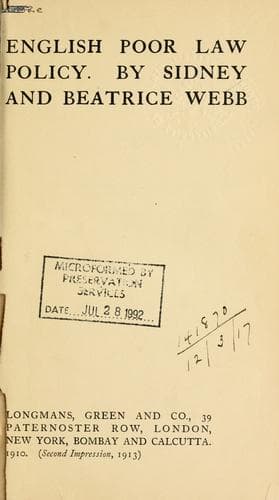
Great Britain. Royal Commission on Poor Laws and Relief of Distress; Poor -- Great Britain; Poor laws -- Great Britain
feeble-minded and morally perverted girls in their adolescence. It is
seen in the fact that, after fifty years of Poor Law Schools, there is
still no classification of the pupils according to their educational
needs; and we find everywhere, sitting side by side, in the same school,
the feeble-minded child, the merely backward child, the precocious young
scholar, and the incipient criminal, all submitted to the same
curriculum, with the same books, under the same teacher. Even in the
latest efforts at classification, by a model Board of Guardians, we
find, housed on the same site and managed by the same superintendent,
the most deserving aged persons, the epileptic patients, and the
able-bodied men relegated to the discipline of "test labour." Such
specialised institutions as have come into existence under a Destitution
Authority are, in fact, perpetually crumbling back into the General
Mixed Workhouse. We see no reason to expect that a general Destitution
Authority that was nominated, instead of being elected, would be free
from this besetting tendency.
But the inherent incapacity of any Destitution Authority to cope with
the task comes out most strongly in its inevitable failure to deal with
the "incipient stage." By the very nature of a Destitution Authority it
can deal only with cases of destitution, and the greatest stress is
laid, and rightly laid, on the necessity for this limitation. This means
that it never does, and never can, deal with any disease or any moral
defect, or any injurious influence of any kind, _in its incipient
stage_. An independent citizen who begins in any way to be adversely
affected in mind, body, or estate, in such a manner as to be reduced to
a state of destitution, does not, in most cases, suddenly, or even
quickly, reach that depth. The evil influence takes some time to bring
him down. All that time, whilst the progress of the disease may still be
arrested, and a cure is possible, Destitution Authority does not hear of
the case, and would be legally precluded from intervening, even if it
did hear of it, _because there is not yet any destitution_. Eventually,
when the case has become so bad that employment is lost, savings are
dissipated and friends exhausted, resort is had to the Destitution
Authority. But the case is then too far gone for any useful
intervention. All that can then be done is, whatever the case, to
administer "relief," and ease the patient's sinking into senility or the
grave. This inherent defect of a Destitution Authority, which no
alteration of name or composition or policy can remedy, must for ever
prevent it applying curative or restorative treatment in any really
effective way. No Poor Law and no Poor Law Authority, just because it is
a Poor Law and a Poor Law Authority, can ever reach out to anticipate
and ward off destitution _before it has occurred_. And this failure to
get hold of the incipient case applies to all the various kinds of
adverse influences that cause destitution.
Public-domain text, read in full here on John Shaqi.
Reviews
Reviews
No reviews yet
Be the first to share your thoughts on this work.
Elsewhere in the archive
Join the Discussion
Join the discussion
Sign in to leave a comment or review.
Sign InorCreate an account