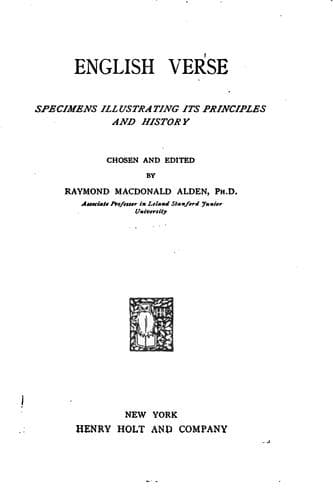
English Verse: Specimens Illustrating its Principles and HistoryAlden, Raymond MacDonald
General
English Verse: Specimens Illustrating its Principles and History
Alden, Raymond MacDonald
English language -- Versification; English poetry
Shepherd, I pray thee stay. Where hast thou been?
Or whither goest thou? Here be woods as green
As any; air likewise as fresh and sweet
As where smooth Zephyrus plays on the fleet
Face of the curled streams; with flowers as many
As the young spring gives, and as choice as any;
Here be all new delights, cool streams and wells,
Arbors o'ergrown with woodbines, caves, and dells;
Choose where thou wilt, whilst I sit by and sing,
Or gather rushes, to make many a ring
For thy long fingers; tell thee tales of love,--
How the pale Phoebe, hunting in a grove,
First saw the boy Endymion, from whose eyes
She took eternal fire that never dies;
How she conveyed him softly in a sleep,
His temples bound with poppy, to the steep
Head of old Latmus, where she stoops each night,
Gilding the mountain with her brother's light,
To kiss her sweetest.
(FLETCHER: _The Faithful Shepherdess_, I. iii. ab. 1610.)
Fletcher uses the couplet in this drama with a freedom hardly found
elsewhere until the time of Keats; see the remark of Symonds, quoted p.
210, below.
If Rome so great, and in her wisest age,
Fear'd not to boast the glories of her stage,
As skilful Roscius, and grave Æsop, men,
Yet crown'd with honors, as with riches, then;
Who had no less a trumpet of their name
Than Cicero, whose every breath was fame:
How can so great example die in me,
That, Allen, I should pause to publish thee?
Who both their graces in thyself hast more
Outstript, than they did all that went before:
And present worth in all dost so contract,
As others speak, but only thou dost act.
Wear this renown. 'Tis just, that who did give
So many poets life, by one should live.
(BEN JONSON: _Epigram LXXXIX, to Edward Allen._ 1616.)
Jonson is thought by some to have been the founder of the classical
school of the seventeenth and eighteenth centuries, which made the
heroic couplet peculiarly its own. See on this subject an article by
Prof. F. E. Schelling, "Ben Jonson and the Classical School," in the
_Publications of the Modern Language Association_, n. s. vol. vi. p.
221. Professor Schelling finds in Jonson's verse all the characteristics
of the later couplet of Waller and Dryden: end-stopped lines and
couplets, a preference for medial cesura, and an antithetical structure
of the verse. "No better specimen of Jonson's antithetical manner could
be found," he says further, than the Epigram here quoted. So far as this
antithetical quality of Jonson's verse is concerned, Professor
Schelling's view cannot be questioned; but that Jonson shows any
singular preference for end-stopped lines and couplets may be seriously
questioned.
Public-domain text, read in full here on John Shaqi.
Reviews
Reviews
No reviews yet
Be the first to share your thoughts on this work.
Elsewhere in the archive
Join the Discussion
Join the discussion
Sign in to leave a comment or review.
Sign InorCreate an account