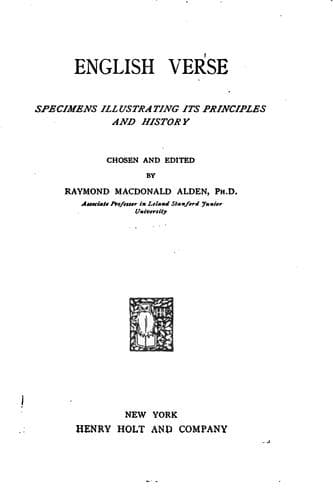
English Verse: Specimens Illustrating its Principles and HistoryAlden, Raymond MacDonald
General
English Verse: Specimens Illustrating its Principles and History
Alden, Raymond MacDonald
English language -- Versification; English poetry
But say, what is't that binds your hands? does fear
From such a glorious action you deter?
Or is't religion? But you sure disclaim
That frivolous pretence, that empty name;
Mere bugbear word, devis'd by us to scare
The senseless rout to slavishness and fear,
Ne'er known to awe the brave, and those that dare.
Such weak and feeble things may serve for checks
To rein and curb base-mettled heretics, ...
Such whom fond in-bred honesty befools,
Or that old musty piece, the Bible, gulls.
(JOHN OLDHAM: _Satires upon the Jesuits_, Sat. i. 1679.)
"Oldham was the first," says Mr. Gosse, "to liberate himself, in the use
of the distich, from this under-current of a stanza, and to write heroic
verse straight on, couplet by couplet, ascending by steady strides and
not by irregular leaps. (Any one who will venture to read Oldham's
disagreeable _Satire upon the Jesuits_, written in 1679, will see the
truth of this remark, and note the effect that its versification had
upon that series of Dryden's satires which immediately followed it.) In
Pope's best satires we see this art carried to its final perfection;
after his time the connecting link between couplet and couplet became
lost, and at last in the decline poems became, as some one has said,
mere cases of lancets lying side by side. But in Dryden's day the
connection was still only too obvious, and it strikes me that it may
have been from a consciousness of this defect, that Dryden adopted that
triplet, with a final alexandrine, which he is so fond of introducing."
(_From Shakespeare to Pope_, p. 201.)
Of these the false Achitophel was first,
A name to all succeeding ages curst:
For close designs and crooked counsels fit,
Sagacious, bold, and turbulent of wit,
Restless, unfixed in principles and place,
In power unpleased, impatient of disgrace;
A fiery soul, which, working out its way,
Fretted the pigmy body to decay,
And o'er-informed the tenement of clay.
A daring pilot in extremity,
Pleased with the danger, when the waves went high,
He sought the storms; but, for a calm unfit,
Would steer too nigh the sands, to boast his wit.
Great wits are sure to madness near allied,
And thin partitions do their bounds divide;
Else, why should he, with wealth and honor blest,
Refuse his age the needful hours of rest?
Punish a body which he could not please,
Bankrupt of life, yet prodigal of ease?...
In friendship false, implacable in hate,
Resolved to ruin or to rule the state;
To compass this the triple bond he broke,
The pillars of the public safety shook,
And fitted Israel for a foreign yoke;
Then, seized with fear, yet still affecting fame,
Usurped a patriot's all-atoning name.
(DRYDEN: _Absalom and Achitophel_, part I. ll. 150-179. 1681.)
Public-domain text, read in full here on John Shaqi.
Reviews
Reviews
No reviews yet
Be the first to share your thoughts on this work.
Elsewhere in the archive
Join the Discussion
Join the discussion
Sign in to leave a comment or review.
Sign InorCreate an account