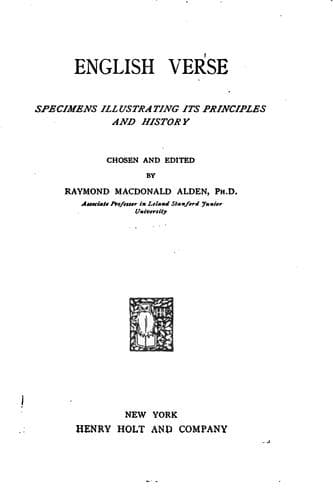
English Verse: Specimens Illustrating its Principles and HistoryAlden, Raymond MacDonald
General
English Verse: Specimens Illustrating its Principles and History
Alden, Raymond MacDonald
English language -- Versification; English poetry
So stood she murmuring, till a rippling sound
She heard, that grew until she turned her round
And saw her other sisters of the deep
Her song had called while Hylas yet did sleep,
Come swimming in a long line up the stream,
And their white dripping arms and shoulders gleam
Above the dark grey water as they went,
And still before them a great ripple sent.
But when they saw her, toward the bank they drew,
And landing, felt the grass and flowers blue
Against their unused feet; then in a ring
Stood gazing with wide eyes, and wondering
At all his beauty they desired so much.
And then with gentle hands began to touch
His hair, his hands, his closed eyes; and at last
Their eager naked arms about him cast,
And bore him, sleeping still, as by some spell,
Unto the depths where they were wont to dwell;
Then softly down the reedy bank they slid,
And with small noise the gurgling river hid
The flushed nymphs and the heedless sleeping man.
(WILLIAM MORRIS: _Life and Death of Jason_, iv. 621-641. 1867.)
B.--BLANK VERSE
Unrimed five-stress verse early became the accepted form for English
dramatic poetry, and in the modern English period has become the
favorite form for long continuous poems, narrative and reflective as
well. In general, as will appear from the specimens, it is marked not
only by the absence of rime but by a prevalent freedom of structure
rarely found in the couplet.
The impetus toward the writing of blank verse seems to have been given
by the influence of classical humanism, the representatives of which
grew sceptical as to the use of rime, on the ground that it was not
found in classical poetry. In Italy Giovanni Trissino wrote his
_Sophonisbe_ and _Italia Liberata_ (1515-1548) in rimeless verses, and
was looked upon as the inventor of _versi sciolti_, _i.e._ verses
"freed" from rime. (See Schipper, vol. ii. p. 4.) See also below, in the
notes on Surrey, and later under Imitations of Classical Verse, for
notes on the same movement.
On the nature of English blank verse, see J. A. Symonds's _Blank Verse_
(1895), a reprint of essays in the Appendix to his _Sketches and Studies
in Southern Europe_. In his _Chapters on English Metre_ (chap. iv.), Mr.
J. B. Mayor criticises what he calls Mr. Symonds's "æsthetic
intuitivism."
On the early history of English blank verse, see the article by Schröer,
_Anfänge des Blankverses in England, Anglia_, vol. iv. p. 1, and Mr. G.
C. Macaulay's _Francis Beaumont_, pp. 39-49.
Public-domain text, read in full here on John Shaqi.
Reviews
Reviews
No reviews yet
Be the first to share your thoughts on this work.
Elsewhere in the archive
Join the Discussion
Join the discussion
Sign in to leave a comment or review.
Sign InorCreate an account