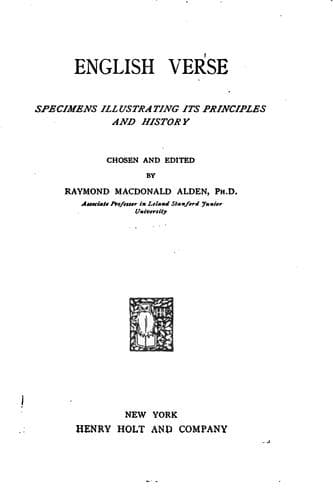
English Verse: Specimens Illustrating its Principles and HistoryAlden, Raymond MacDonald
General
English Verse: Specimens Illustrating its Principles and History
Alden, Raymond MacDonald
English language -- Versification; English poetry
The verse of Fletcher is highly individual among the Jacobean
dramatists, though in a sense typical of the breaking down of blank
verse, in the direction of prose, which was going on at this period. The
distinguishing feature of Fletcher's verse is the constant use of
feminine endings, and the extension of these to triple and even
quadruple endings, by the addition of one or more syllables.
Twelve-syllable lines (not alexandrines, but ordinary lines with triple
endings) are not at all uncommon; and the additional syllable or
syllables may even be emphatic. In general the tendency was in the
direction of the freedom of conversational prose. Such a line as
"Methinks you are infinitely bound to her for her journey"
would not be recognized, standing by itself, as a five-stress iambic
verse; properly read, however, it takes its place without difficulty in
the scheme of the metre.[30]
Whatever ails me, now a-late especially,
I can as well be hanged as refrain seeing her;
Some twenty times a day, nay, not so little,
Do I force errands, frame ways and excuses,
To come into her sight; and I've small reason for't,
And less encouragement, for she baits me still
Every time worse than other; does profess herself
The cruellest enemy to my face in town;
At no hand can abide the sight of me,
As if danger or ill luck hung in my looks.
I must confess my face is bad enough,
But I know far worse has better fortune,
And not endur'd alone, but doted on;
And yet such pick-hair'd faces, chins like witches',
Here and there five hairs whispering in a corner,
As if they grew in fear of one another,
Wrinkles like troughs, where swine-deformity swills
The tears of perjury, that lie there like wash
Fallen from the slimy and dishonest eye;
Yet such a one plucks sweets without restraint.
(THOMAS MIDDLETON: _The Changeling_, II. i. ab. 1623.)
Middleton carried on the work of fitting blank verse for plausibly
conversational, as distinguished from poetic, effects. Often his lines
are more difficult to scan than Fletcher's, and still less seek
melodiousness for its own sake. Characteristic specimens are verses like
these:
"I doubt I'm too quick of apprehension now."
"With which one gentleman, far in debt, has courted her."
"To call for, 'fore me, and thou look'st half ill indeed."
Public-domain text, read in full here on John Shaqi.
Reviews
Reviews
No reviews yet
Be the first to share your thoughts on this work.
Elsewhere in the archive
Join the Discussion
Join the discussion
Sign in to leave a comment or review.
Sign InorCreate an account