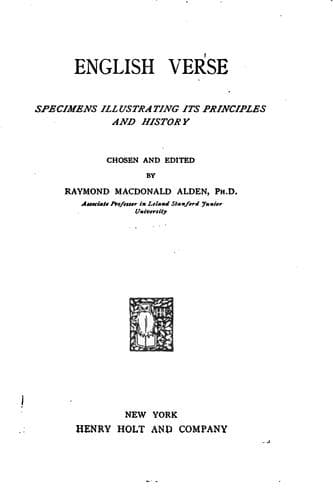
English Verse: Specimens Illustrating its Principles and HistoryAlden, Raymond MacDonald
General
English Verse: Specimens Illustrating its Principles and History
Alden, Raymond MacDonald
English language -- Versification; English poetry
Through the hushed air the whitening shower descends,
At first thin wavering; till at last the flakes
Fall broad, and wide, and fast, dimming the day
With a continual flow. The cherished fields
Put on their winter-robe of purest white.
'Tis brightness all; save where the new snow melts
Along the mazy current. Low the woods
Bow their hoar head; and, ere the languid sun
Faint from the west emits his evening ray,
Earth's universal face, deep-hid and chill,
Is one wild dazzling waste, that buries wide
The works of man. Drooping, the laborer-ox
Stands covered o'er with snow, and then demands
The fruit of all his toil. The fowls of heaven,
Tamed by the cruel season, crowd around
The winnowing store, and claim the little boon
Which Providence assigns them. One alone,
The redbreast, sacred to the household gods,
Wisely regardful of the embroiling sky,
In joyless fields and thorny thickets leaves
His shivering mates, and pays to trusted man
His annual visit. Half-afraid, he first
Against the window beats; then, brisk, alights
On the warm hearth; then, hopping o'er the floor,
Eyes all the smiling family askance,
And pecks, and starts, and wonders where he is--
Till, more familiar grown, the table-crumbs
Attract his slender feet.
(THOMSON: _The Seasons; Winter_. 1726.)
Thomson's _Seasons_ was undoubtedly the most influential of the poems of
the blank-verse revival of this period. Saintsbury says: "His blank
verse in especial cannot receive too much commendation. With that of
Milton, and that of the present Poet Laureate [Tennyson], it must rank
as one of the chief original models of the metre to be found in English
poetry." (Ward's _English Poets_, vol. iii. p. 169.)
Other influential poems of the same period, written in blank verse, were
Glover's _Leonidas_ (1737), Young's _Night Thoughts_ (1742-1744), and
Akenside's _Pleasures of the Imagination_ (1744). Much earlier than
these had come the curious poem of John Philips on _Cider_ (1708).
Philips is praised by Thomson as the successor of Milton in some lines
of _Autumn_:
"Philips, Pomona's bard, the second thou
Who nobly durst, in rhyme-unfetter'd verse
With British freedom sing the British song."
In general, the blank verse of all these poets shows the influence of
the couplet and lacks flexibility. Thus Mr. Symonds says: "The use of
the couplet had unfitted poets for its composition. Their acquired
canons of regularity, when applied to loose and flowing metre, led them
astray.... Hence it followed, that when blank verse began again to be
written, it found itself very much at the point where it had stood
before the appearance of Marlowe. Even Thomson ... wrote stiff and
languid blank verse with monosyllabic terminations and monotonous
cadences--a pedestrian style." (_Blank Verse_, pp. 61, 62.)[33]
Public-domain text, read in full here on John Shaqi.
Reviews
Reviews
No reviews yet
Be the first to share your thoughts on this work.
Elsewhere in the archive
Join the Discussion
Join the discussion
Sign in to leave a comment or review.
Sign InorCreate an account