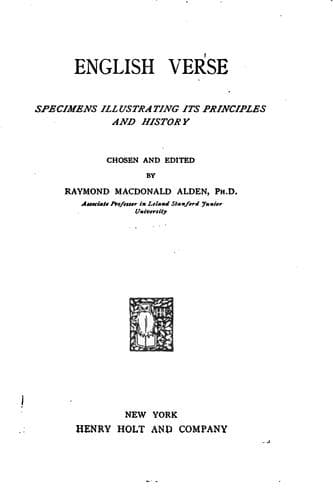
English Verse: Specimens Illustrating its Principles and HistoryAlden, Raymond MacDonald
General
English Verse: Specimens Illustrating its Principles and History
Alden, Raymond MacDonald
English language -- Versification; English poetry
As when about the silver moon, when air is free from wind,
And stars shine clear, to whose sweet beams, high prospects, and the
brows
Of all steep hills and pinnacles, thrust up themselves for shows,
And even the lowly valleys joy to glitter in their sight,
When the unmeasured firmament bursts to disclose her light,
And all the signs in heaven are seen, that glad the shepherd's heart;
So many fires disclosed their beams, made by the Trojan part,
Before the face of Ilion, and her bright turrets show'd.
A thousand courts of guard kept fires, and every guard allow'd
Fifty stout men, by whom their horse eat oats and hard white corn,
And all did wishfully expect the silver-throned morn.
(CHAPMAN: _Iliad_, book VIII. 1610.)
Chapman's translation of _Iliad_ is the longest modern English poem in
septenaries. Professor Newman, however (whose translation gave rise to
Matthew Arnold's lectures _On Translating Homer_), used the same measure
unrimed and with feminine endings; thus,--
"He spake, and yelling, held afront the single-hoofed horses."
Arnold objected to Chapman's measure that "it has a jogging rapidity
rather than a flowing rapidity, and a movement familiar rather than
nobly easy."
Rejoice, oh, English hearts, rejoice! rejoice, oh, lovers dear!
Rejoice, oh, city, town and country! rejoice, eke every shire!
For now the fragrant flowers do spring and sprout in seemly sort,
The little birds do sit and sing, the lambs do make fine sport;
And now the birchen-tree doth bud, that makes the schoolboy cry;
The morris rings, while hobby-horse doth foot it feateously;
The lords and ladies now abroad, for their disport and play,
Do kiss sometimes upon the grass, and sometimes in the hay.
(BEAUMONT: _The Knight of the Burning Pestle_, IV. v. ab. 1610.)
Here the septenary is introduced in the May-day song of Ralph, the
London apprentice, doubtless because of its popularity for such
unliterary verse.
In somer, when the shawes be sheyne,
And leves be large and long,
Hit is full mery in feyre foreste
To here the foulys song.
(_Ballad of Robin Hood and the Monk_, in Gummere's _English Ballads_, p.
77.)
It is an ancient Mariner,
And he stoppeth one of three.
"By thy long grey beard and glittering eye,
Now wherefore stopp'st thou me?" ...
... He prayeth best, who loveth best
All things both great and small;
For the dear God who loveth us,
He made and loveth all.
(COLERIDGE: _The Ancient Mariner_, ll. 1-4, 614-617. 1798.)
Public-domain text, read in full here on John Shaqi.
Reviews
Reviews
No reviews yet
Be the first to share your thoughts on this work.
Elsewhere in the archive
Join the Discussion
Join the discussion
Sign in to leave a comment or review.
Sign InorCreate an account