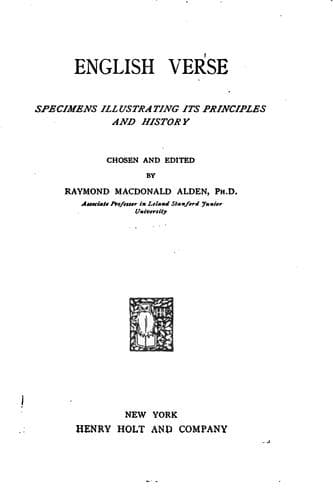
English Verse: Specimens Illustrating its Principles and HistoryAlden, Raymond MacDonald
General
English Verse: Specimens Illustrating its Principles and History
Alden, Raymond MacDonald
English language -- Versification; English poetry
The use of alexandrines and septenaries together, we have seen, was
common even in the Middle English period, but not in regular
alternation. The Chronicle of Robert of Gloucester (about 1300) mingles
both measures, but with alexandrines predominating. In some of the early
Mystery Plays they are found in alternation; for example, where Jacob,
in one of the Towneley plays, is relating his hunger to Esau:
"Meat or drink, save my life, or bread, I reck not what:
If there be nothing else, some man give me a cat."
See also the specimen from _The Marriage of Wit and Science_, p. 256,
above.
Schipper says that he does not know who first brought the two measures
together in alternate use for lyrical poetry. Guest says that the
Poulter's Measure came into fashion soon after 1500 (_History of English
Rhythms_), but gives no examples so early. The history of the measure
should be further investigated.
After the Elizabethan period the Poulter's Measure practically
disappears from English poetry. A curious suggestion of it may be found
in a little poem of Leigh Hunt's (_Wealth and Womanhood_), cited by
Schipper, who calls the verse "Poulter's Measure in trochaics":
"Have you seen an heiress in her jewels mounted,
Till her wealth and she seemed one, and she might be counted?"
Laid in my quiet bed, in study as I were,
I saw within my troubled head a heap of thoughts appear:
And every thought did show so lively in mine eyes,
That now I sighed, and then I smiled, as cause of thought doth rise.
(EARL OF SURREY: _How no Age is Content with his Own Estate_, in
Tottel's _Songs and Sonnets_. Arber's Reprint, p. 30. Pub. 1557.)
Her forehead jacinth like, her cheeks of opal hue,
Her twinkling eyes bedeck'd with pearl, her lips as sapphire blue;
Her hair like crapal stone, her mouth O heavenly wide;
Her skin like burnish'd gold, her hands like silver ore untried.
(SIR PHILIP SIDNEY: _Mopsa_, in the _Arcadia_. ab. 1580.)
IV. THE SONNET
The sonnet is an Italian verse-form, in fourteen five-stress lines,
introduced into England at the time of the Italian literary influences
of the sixteenth century. Almost from the first, the English sonnet has
been divided into two classes: one based on more or less strict
imitation of the structure of the Italian form, and variously called the
Italian, the regular, or the legitimate sonnet; the other taking the
Italian sonnet as the point of departure, but constructed according to
more familiar English rime-schemes, and commonly called the Shaksperian
or the English sonnet.
Public-domain text, read in full here on John Shaqi.
Reviews
Reviews
No reviews yet
Be the first to share your thoughts on this work.
Elsewhere in the archive
Join the Discussion
Join the discussion
Sign in to leave a comment or review.
Sign InorCreate an account