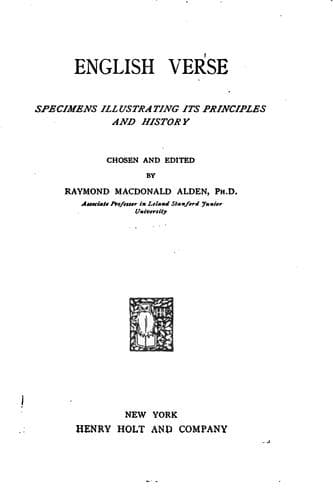
English Verse: Specimens Illustrating its Principles and HistoryAlden, Raymond MacDonald
General
English Verse: Specimens Illustrating its Principles and History
Alden, Raymond MacDonald
English language -- Versification; English poetry
Since there's no help, come let us kiss and part,--
Nay I have done, you get no more of me;
And I am glad, yea, glad with all my heart,
That thus so cleanly I myself can free;
Shake hands for ever, cancel all our vows,
And when we meet at any time again,
Be it not seen in either of our brows
That we one jot of former love retain.
Now at the last gasp of love's latest breath,
When, his pulse failing, passion speechless lies,
When faith is kneeling by his bed of death,
And innocence is closing up his eyes,
--Now if thou would'st, when all have given him over,
From death to life thou might'st him yet recover!
(DRAYTON: _Love's Farewell_. 1594.)
Rossetti called this sonnet "perhaps the best in the language."
Drayton's sonnet-sequence, the _Idea_, follows the Shaksperian form; and
the present specimen illustrates how the important division of this type
of sonnet is between the quatrains and the final couplet.
One day I wrote her name upon the strand;
But came the waves and washed it away:
Again I wrote it with a second hand,
But came the tide and made my pains his prey.
Vain man! said she, that dost in vain essay
A mortal thing so to immortalize;
For I myself shall like to this decay,
And eke my name be wiped out likewise.
Not so (quoth I); let baser things devise
To die in dust, but you shall live by fame;
My verse your virtues rare shall eternize,
And in the heavens write your glorious name,--
Where, whenas death shall all the world subdue,
Our love shall live, and later life renew.
(SPENSER: _Amoretti_, lxxv. 1595.)
The sonnets in Spenser's collected poems number 177, of which fifty-six
are in the common English (Surrey) form, the remainder--like the present
specimen--riming _ababbcbccdcdee_. This order of rimes reminds us of
that in the Spenserian stanza, and must have been devised by Spenser at
about the same time. It has never been adopted by other poets.
When, in disgrace with fortune and men's eyes,
I all alone beweep my outcast state,
And trouble deaf heaven with my bootless cries,
And look upon myself and curse my fate;
Wishing me like to one more rich in hope,
Featured like him, like him with friends possest,
Desiring this man's art, and that man's scope,
With what I most enjoy contented least;
Yet in these thoughts myself almost despising,
Haply I think on thee--and then my state,
Like to the lark at break of day arising
From sullen earth, sings hymns at heaven's gate;
For thy sweet love remember'd such wealth brings
That then I scorn to change my state with kings.
(SHAKSPERE: _Sonnet_ xxix. 1609.)
Public-domain text, read in full here on John Shaqi.
Reviews
Reviews
No reviews yet
Be the first to share your thoughts on this work.
Elsewhere in the archive
Join the Discussion
Join the discussion
Sign in to leave a comment or review.
Sign InorCreate an account